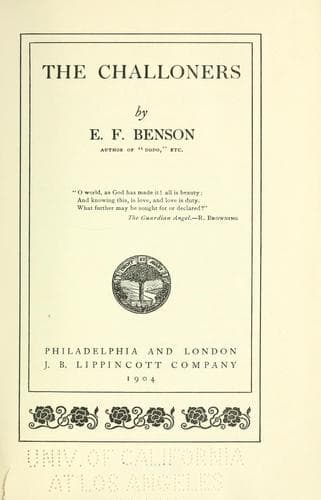
Clergy -- England -- Fiction; England -- Social life and customs -- Fiction; Families -- England -- Fiction
“The blind man said it must be like the sound of a trumpet,” said Karl;
“and the blind man at that moment saw. Brandy also for taste is red. So
is ammonia,--a pistol to your nostrils.”
Martin dabbed his cigarette on to his dessert plate.
“Yes, yes,” he cried, “and C major is red. And F sharp is
blue,--electric blue, like the grotto at Capri----“
He stopped suddenly.
“Am I talking nonsense?” he asked. “If so, it is your fault. You
encourage me. You meant to. And what do you mean me to get from it?”
Karl turned directly towards him.
“I mean you to think,” he said. “To frame your life wholly for beauty
in whatever form you see it. It is everywhere, be assured of that; and
if your eye sees it, store it up like a honey-bee, and bring it home. If
your mouth feels it, bring it home. If you smell the autumn morning,
bring that home, too. It all makes music.”
He pushed his plate aside and leaned forward towards Martin.
“All is food for you,” he said. “It is only in that way, by harvesting
every grain of corn you see, that you can be great. A lot of harvesting
is done unconsciously. Supplement that by conscious harvesting. You may
learn perfectly all the harmony and counterpoint that can be learned,
you may learn to play things impossible, but all that is no good by
itself. You can already play,--I am not flattering you, but the
reverse,--if you practise a little, all the printed music ever written,
as far as notes go. That is no good either. But--if I had not seen this
when first I heard you play, I should never have wasted ten minutes of
my time on you--you can do more than that. You can, if you are very
alert, quite untiring, very critical, and always ready to catch beauty
in whatever form it may present itself, you can do more than this. At
least I believe so.”
He got up from his seat and leaned his hands on the boy’s shoulders as
he sat by the table.
“Ah, Martin, don’t disappoint me,” he said, “or, being old, I shall die
of it. Drink from every spring but one, and drink deep.”
Martin turned in his chair and faced him.
“Do I know what spring you mean?” he asked. “Love?”
Karl looked at him with a sort of wonder.
“No, I did not mean that,” he said.
He drew a long breath.
“My God, if that had been granted to me,” he said, “I too might have
been great. But I never fell in love. Oh, I am successful; I know I
understand; I am the only person, perhaps, who does know what is missing
in me. It is that. But missing that, I never, no, not once, parodied
what I did not know. Parody, parody!” he repeated.
Martin looked at him with that direct, lucid gaze Karl knew so well,
level beneath the straight line of his eyebrows. His smooth, brown
cheeks were a little flushed with some emotion he could not have put a
name to. Slight injury was there, that Karl could possibly have supposed
him bestial, the rest was clean modesty.
“I am not beastly,” he said, “if you mean that.”
“I did mean that,” he said. “And I beg your pardon.”
Martin stood up.
Public-domain text, read in full here on John Shaqi.
Reviews
Reviews
No reviews yet
Be the first to share your thoughts on this work.
Elsewhere in the archive
Join the Discussion
Join the discussion
Sign in to leave a comment or review.
Sign InorCreate an account