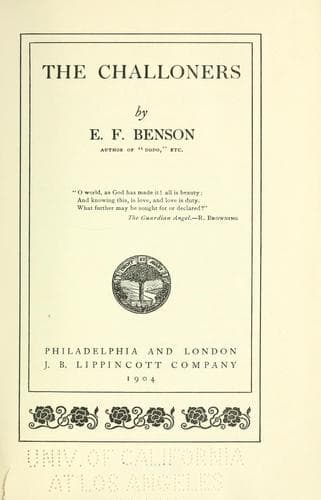
Clergy -- England -- Fiction; England -- Social life and customs -- Fiction; Families -- England -- Fiction
“I have been wanting to talk to you often before about that,” he said,
“so let me say once and for all what is in my mind. I disagree with you,
as you know, vitally, essentially, and I believe that God tells me to
disagree. But now I believe also, dear,--and this your goodness and your
sweet patience all these months has taught me,--that God tells you to
do as you are going to. How that is I do not understand. Perhaps that
doesn’t matter so much as I used to think. But He fulfils Himself in
many ways. And there, too, I have very often thought that He had to
fulfil Himself in my way. It is you who have made me see that, I think.”
Helen raised shining eyes to his.
“You have made me very happy,” she said.
“And what have you done for me? There were certain days, dear, during
this winter which I do not see how I could have got through without
you.”
Here was an opportunity for which Helen had often sought.
“Martin?” she asked. “Oh, father, I wonder if you want Martin as much as
I do.”
The strength and the tenderness died out of his face, leaving it both
helpless and hard.
“I can’t see him,” he said, quickly; “I dare not. Some day, perhaps; but
if I saw him now I should say--I could not, I know, help saying--what I
feel. If that would do any good, I would say it; but it would do none. I
should only--I should only frighten him,” he said, with an accent
infinitely pathetic.
* * * * *
She left him then without more words, for all this winter she had been
learning every day and all day long the divine and human gospel of
patience in dealing with people,--the patience that teaches us not to
pull buds open, however desirable it may be that the flower should
unfold, that is content to do its best with them, and wait for results
without the desire even that they should come quickly. Till this
evening, as has been said, Martin’s name had scarcely been mentioned by
his father, and it was something, after this bitterness of long silence,
that he should be able to say “Not yet, not now.” Pity also, pity with
hands of healing, had entered at last into that stern, upright,
God-fearing soul, filtering its way like water through dry and stony
soil; a very exiguous trickle it might be, but cool, liquid, refreshing.
How hardly it had won its way there Helen but guessed dimly, he alone
knew. For day had succeeded day, and week week, and all day and all week
he had wrestled blindly, hopelessly with the misery that Martin had
brought on him, unable for all his efforts to find any possible
justifying cause for what he had done, which seemed to him as wanton and
as wicked as violent crime. To his Puritan mind, Martin’s
reason,--namely, the craving for and the necessity of beauty and poetry
in religion was as unintelligible as a page in an unknown language; not
knowing at all what that craving meant, any more than he knew what
homicidal mania meant to a maniac, he could not in any degree whatever
feel or appreciate its force.
Public-domain text, read in full here on John Shaqi.
Reviews
Reviews
No reviews yet
Be the first to share your thoughts on this work.
Elsewhere in the archive
Join the Discussion
Join the discussion
Sign in to leave a comment or review.
Sign InorCreate an account