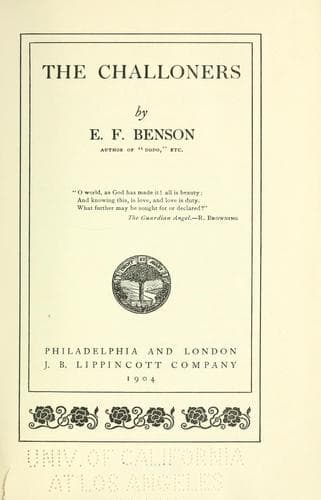
Clergy -- England -- Fiction; England -- Social life and customs -- Fiction; Families -- England -- Fiction
Mr. Challoner walked swiftly homewards after Helen had left him, feeling
strangely and deeply moved by the news. He felt somehow that his
children were his children no longer; all the responsibility for them
had passed into other hands, and they themselves, light-heartedly,
eagerly, were now taking on themselves the responsibility for others. He
had thought of them always as a boy and a girl, each bound to obedience
to his will, dependent on him, without any real, individual existence of
their own. But within the last year first one and now the other was
passing out of his reach. Helen first and then Martin had acted for
themselves in direct defiance not only of his wish, but of that which
was the mainspring and motive of his life. She, it is true, by these
months of quiet, normal life at home had made a great change in him; her
disobedience to him personally had vanished from his mind, and, as he
had told her last night, though he believed no less strongly than before
that his conviction with regard to her marriage was the will of God for
him, he believed also, though he could not understand how, that she,
too, was acting consonantly to that same will. But with regard to
Martin, however he looked at his conduct, or whatever possible
interpretation he tried to put on it, he could not see light. He was
trivial, superficial, not in earnest about religious matters, just as he
had been in the rest of his education. Nothing, except music, which Mr.
Challoner could not frankly bring himself to regard as anything but a
mere æsthetic fringe, a mere ornament of life, had ever touched him
deeply. He had no depth, no seriousness. And now that boy, that child,
was going to be married, to take upon himself with the same
light-hearted _insouciance_ all the responsibilities of a husband and a
father.
How strange that they were twins! Helen developing every day in
patience, dutifulness, love; and Martin, still thoughtless, bent only on
the personal gratification of his musical tastes, and willing, so Mr.
Challoner bitterly put it to himself, to leave the English Church, the
mother of his faith, for the sake of a hymn-tune! He would write to him,
as he had said, but even now he could not see him. For he knew himself
well, and recognised, though he scarcely wished to cure his own
impatience, his anger at one who seemed to him to be going wrong
wilfully. On a point like this he could make no concession, for any
concession implied a failure of loyalty on his own part to his creed.
Public-domain text, read in full here on John Shaqi.
Reviews
Reviews
No reviews yet
Be the first to share your thoughts on this work.
Elsewhere in the archive
Join the Discussion
Join the discussion
Sign in to leave a comment or review.
Sign InorCreate an account