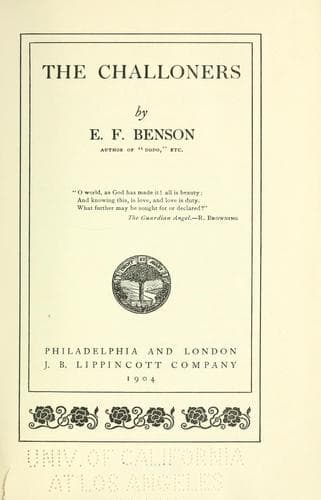
Clergy -- England -- Fiction; England -- Social life and customs -- Fiction; Families -- England -- Fiction
But he had come to Chartries with the definite object of seeing his
father, and while Helen’s luggage was being put into the pony-cart from
the vicarage the two talked this over.
“It’s no use putting it off,” he said, “so will you tell father that
unless I hear from him to stop me, I will come over to-morrow afternoon
to see him. And I hope,” he added, with his usual candour, “that my
temper will be a little improved by then. Lord, how cross I feel! And
this time yesterday I was in the middle of it all.”
Helen looked at him a moment rather anxiously.
“You’re all right, aren’t you, Martin?” she said; “not ill?”
“Ill? No. But I’m all on edge and I’ve got two headaches. It’s rather
cold waiting here. I think I’ll walk on and let the carriage catch me
up. Good-bye, Helen; see you to-morrow.”
* * * * *
Martin woke next morning, after long, heavy sleep, with the same sense
of lassitude and tiredness which had oppressed him all the day before
and the same headache lying like a hot metallic lump inside his head,
pressing the back of his eyes. The man who called him had brought him a
couple of letters and a note from his father, which had been sent over
from the vicarage. He opened this first.
“MY DEAR MARTIN,--Helen has given me your message, that you wish to
see me. I have thought about it very carefully, and I wish to tell
you quite candidly the conclusion I have come to.
“You know what I felt about your going over to the Roman Church; I
feel that all still, and as strongly as ever. You have deliberately
left your own church, and for reasons, as far as I can understand,
which are frivolous and unessential. And I am afraid--I know in
fact--that if I saw you I should, without being able to help
myself, express to you what I feel. Now, I do not think this would
do any good, it would only widen the gulf between us; and one of
the great aims of my life now is to do the opposite. I do not
suppose my opinion will ever change, it cannot, in fact, but in
time I shall, I suppose, get more used to what has happened, and
shall be able to see you without bitterness. At present I am
unwilling to tear open a wound which may be beginning to heal. But
all this is to me still so keen a daily and hourly pain that I feel
sure we should be wiser not to meet yet. But Helen, of course, is
quite free to come and see you, and you to come and see her.
“It gives me great pain to write this. But I cannot separate you
from what you have done.
“I am rejoiced to hear from her of the great success of your
concert. Personally, as you know, I have no educated taste in
music, but I gather that your master is satisfied both with your
progress and your industry, which is more important than success.
“My dear boy, I wish I could see you; I wish I could trust myself!
“Your affectionate father,
Public-domain text, read in full here on John Shaqi.
Reviews
Reviews
No reviews yet
Be the first to share your thoughts on this work.
Elsewhere in the archive
Join the Discussion
Join the discussion
Sign in to leave a comment or review.
Sign InorCreate an account