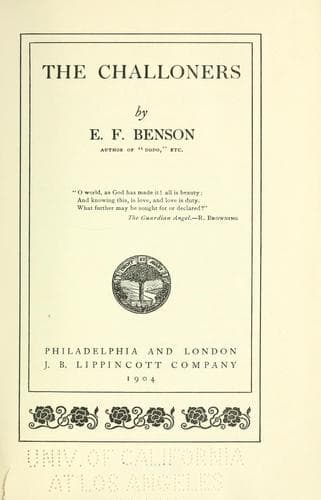
Clergy -- England -- Fiction; England -- Social life and customs -- Fiction; Families -- England -- Fiction
The worshippers were but few, and it was not long before Martin was out
in the sunshine again, but with all the joy and exhilaration of the
earlier hour by the river driven out of him. Like most very emotional
people, religion was as essential to him as breathing, but in him it was
a natural, child-like religion that springs primarily from the huge
enjoyment of the beautiful things in this world, for which he had to
thank somebody. And though it would be impossible to say that it was not
real to him, yet a London fog, so to speak, would make a pagan of him
for the time being. And now, though he did believe in the truth and
reality of the service in which he had taken part, the deadly ugliness
of the church, the melancholy voices, Mr. Milton’s “Kyrie” ten times
repeated, the intolerable voices singing absurd tunes had risen like a
London fog between him and it. The service had passed over his head
like a flight of birds unseen in this dreadful atmosphere, he had heard
only the rustle of their wings. But what he had been conscious of with
every jarred fibre in his being was the gross material ugliness of the
sights and sounds of this last hour. Why should “throne” be allowed to
rhyme with “join” in sacred subjects, whereas it would be admissible in
no other class of poetry? Was it because anything was good enough in a
hymn, or because those who were responsible for the “form” of English
worship were entirely without any sense of “form” themselves? Or why in
church allow music that would be tolerated nowhere else? Or why have
windows in the house of God which for colouring and design could only be
paralleled in the worst type of suburban villa? Pitch-pine seats, tiles
again only to be found in the fireplaces of villas and the aisles of
churches! Often before, though never perhaps so vividly, had the
ugliness of Protestantism struck him; often before, though never perhaps
so insistently, had his nature, wishing to aspire, demanded beauty as
its ladder. Most of all here was beauty necessary, for the sublimest act
of all was here performed, the worship and praise of God, the
sacramental approach to him. Even as a little thing, a little rhythmical
noise, may utterly distract a man’s attention from a subject which
requires concentration, so this ambient ugliness utterly distracted
Martin. Only ugliness was no little thing to him.
He had not long to wait for his father, for he followed him almost
immediately out of the vestry, and his face lit up with extraordinary
pleasure when he saw that Martin had waited for him. Here was his
highest joy: to see his children with him in that divine act, and find
them caring, lingering for him, and the consciousness of that compact
the night before was as vividly present in his mind as it had been in
Martin’s when he left the delights of the river-bank at the sound of the
church-bell.
“Dear lad,” he said, “the first thing I saw when I came into church was
you, and I was so thankful.”
Public-domain text, read in full here on John Shaqi.
Reviews
Reviews
No reviews yet
Be the first to share your thoughts on this work.
Elsewhere in the archive
Join the Discussion
Join the discussion
Sign in to leave a comment or review.
Sign InorCreate an account