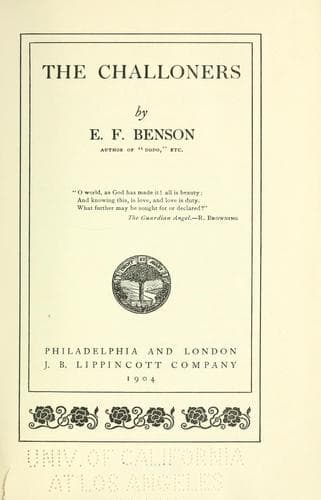
Clergy -- England -- Fiction; England -- Social life and customs -- Fiction; Families -- England -- Fiction
Then two small incidents happened. Martin dropped a plate with a
hideous clatter, and a moment afterwards upset a wineglass, which he had
just filled with claret, all over the table. He apologised and wiped it
up, but, unfortunately, looking up, he saw his father’s face wearing
such an extraordinary expression of true Christian patience that for the
life of him he could not help giving a sudden giggle of laughter. He
could not possibly have helped it; if he was going to be hung for it he
must have laughed.
Now, the laughter of other people when we ourselves do not see anything
whatever in the situation to provoke mirth is one of the authentic
trials of life, especially if one half suspects, as Mr. Challoner did
now, that one is in some manner inexplicable to one’s self the cause of
it. It was therefore highly to his credit that, remembering the
interview he had had with Martin the night before, he could manage to
keep inside his lips the words that tingled on his tongue. Of more than
that he was incapable; he could not just then be genial or start a
subject of conversation, he could only just be silent.
Martin could easily manage that; his last observation had not found
favour, and he held his tongue and ate large quantities of cold beef.
Helen sitting opposite her father, in the absence of Aunt Clara, who was
spending the Sunday away, had also nothing apparently which she
considered as suitable, and the meal proceeded in silence. Then, after a
long pause, she raised her eyes, which so happened to catch Martin’s,
who was still struggling with his unseemly mirth. At this moment also
her father looked up and saw a glance which he interpreted into a glance
of meaning pass between them, a thing irritating to the most placid
temperament. He saw, too, the corners of Martin’s mouth twitching. This
was too much.
“I will not have that sort of thing, children,” he said, his voice
rising sharply. “It is an extremely rude and vulgar thing to exchange
glances like that.”
Martin’s merriment was struck as dead as beech-leaves in frost.
“I was doing nothing of the kind,” he said, his temper flashing out.
“Helen looked up at the same moment as I looked up. We all three looked
up, in fact. It was purely accidental.”
Helen was vexed that Martin should speak so, but felt bound to endorse
him.
“Indeed, father, it is so,” she said.
Again the silence descended, and Martin, seeing that both his father and
sister had finished their meat, changed their plates and arranged the
second course. After a very long pause their father spoke again.
“I should have thought my children might have had something to say to me
in the evening when they have left me alone all day, enjoying themselves
elsewhere. Has nothing happened to you since breakfast which I am worthy
of hearing?”
Martin’s intolerance of this injustice again stung him into ill-advised
speech.
Public-domain text, read in full here on John Shaqi.
Reviews
Reviews
No reviews yet
Be the first to share your thoughts on this work.
Elsewhere in the archive
Join the Discussion
Join the discussion
Sign in to leave a comment or review.
Sign InorCreate an account