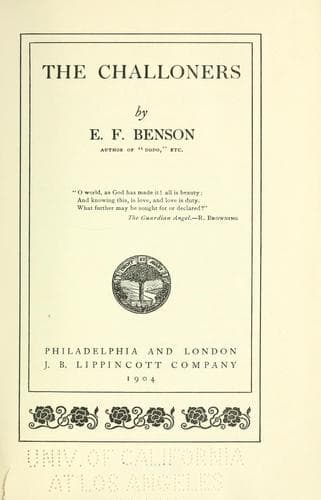
Clergy -- England -- Fiction; England -- Social life and customs -- Fiction; Families -- England -- Fiction
“It is good of you,--I mean about Martin,” she said. “That is just what
he wants, to go among people who will take him and his music seriously,
not gasp just because he plays extremely fast. No one here really knows
the difference between Rule Britannia and the Dead March. And
yesterday--oh dear! oh dear!” And she broke out laughing.
“There isn’t much,” observed Frank, parenthetically. “But please tell me
about yesterday.”
“I think I must, because, though you will laugh, you will laugh kindly.
It was at the early service, and the dear boy played the overture to
‘Lohengrin’ as a voluntary, and my father thought it wasn’t quite
suitable.”
He considered this a moment.
“Do you know, I don’t think I want to laugh at all?” he said. “I
understand perfectly.”
“But Martin didn’t. That was so funny.”
“No, he wouldn’t. That is one of the penalties of genius. In fact, it is
what genius means. It is having one point of view so vivid that all
others are dark, invisible beside it. And genius is always intolerant.”
Her eye brightened.
“I don’t know if you know or not,” she said, “but I expect you do. Is
Martin really all that,--dear, stupid, old Martin?”
“I believe so. We are going to get him to London to find out. You will
give him my message, won’t you? I go up to town to-day, and he may come
any day he likes; the sooner the better. Lady Sunningdale is writing to
you.”
“Oh, it would be heavenly!” said she.
He took his leave soon after, and went back to Chartries for an early
lunch, since Lady Sunningdale, who never started anywhere in the
morning, unless it was impossible to get there otherwise, had retained
his services in order to minimize the dangers and difficulties incident
to travel by rail with Suez Canal and Sahara. For Sahara had an
unreasoning dislike of locomotive engines, which had never, at present,
hurt her, and always tried to bite them, while Suez Canal, whenever it
was feasible, jumped down between the platform and the train and smelled
about for whatever there might be of interest among the wheels of the
carriages. In addition to these excitements, their mistress never moved
without a tea-basket, a collapsible card-table,--which usually
collapsed,--a small library of light literature, a jewel-case, so that
the tedium of a journey in her company was reduced to a minimum, since
when the train was in motion these recreations could be indulged in, and
when it stopped there was more than enough to be done in collecting
these priceless impedimenta to prevent any companion of hers from
feeling a moment’s boredom that arose from idleness.
She also could hardly ever produce either her own or the dogs’ railway
tickets when called upon to do so, thus giving use to games of
hide-and-seek all over the carriage.
Public-domain text, read in full here on John Shaqi.
Reviews
Reviews
No reviews yet
Be the first to share your thoughts on this work.
Elsewhere in the archive
Join the Discussion
Join the discussion
Sign in to leave a comment or review.
Sign InorCreate an account