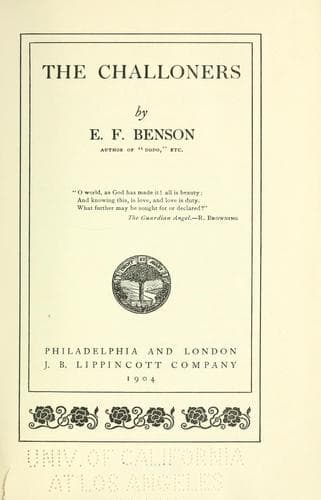
Clergy -- England -- Fiction; England -- Social life and customs -- Fiction; Families -- England -- Fiction
Beauty. That was the food for which every fibre of his nature hungered
and with which it would never be satiated. Long ago he had known it, but
known it second-hand, known it as in a dream, when he quoted Browning,
three days ago, to his sister. But that dream, that second-hand
information, had become real and authentic. No matter how trivial might
be the experience, that was what he demanded of all experience,--whether
he ate or drank, it was beauty he craved; whether he ran or sat down, he
knew now that, in so far as it was consciously done, it was the thrill
of speed, the content of rest that he demanded of the function. Then,
suddenly, he asked himself what he demanded in the exercise of the
highest function of all, that of worship--Was it the pitch-pine pew, the
magenta saint, the tuneless chant? Was it the fear of hell, the joy of
an uncomprehended heaven, even though the gate-stones of the New
Jerusalem were of jaspar and agate? Not so; for what did he worship?
Absolute beauty, that quality of which everything that is beautiful has
some grain of mirrored reflection. That was God, the supreme, the
omnipotent, present in all that was beautiful just as much as he was
present in the breaking of the Bread and the outpouring of the mystic
Wine, for all was part of Him.
CHAPTER V
The big drawing-room at Yorkshire House was full to overflowing, and for
the avoidance of asphyxiation the six long windows that looked on to the
Green Park were all open. Louis Seize candlesticks, converted to the
more modern use of electric light, were brilliant on the crimson satin
of the walls, and a couple of dozen rows of chairs, all occupied, were
directed towards the end of the room where the Steinway grand stood.
Behind the chairs there was a throng of standing folk, but, except for
the voice of the piano, no sound broke the stillness. A quarter of an
hour ago the smaller drawing-room opening out of this had been full of
chattering groups, but now it was completely empty, except for some
half-dozen people who had been unable to find a standing-place in the
larger room, and crowded as near as they could to the doorway. But the
last human voice had been that of Martin.
“I’ll play it if you like,” he said, “but it will take nearly half an
hour.”
Then he sat down and, since he had played before, a hush most abnormal
during the ordinary piano solo fell on the “party” which had been
invited in after dinner. Many, no doubt, were unmusical, but more, since
it was Frank’s house and it was he who had invited the guests, had some
instinct for perfection, that bond that joins together all artists. Lady
Sunningdale, of course, was there, and had early established herself in
a front row, and Helen, who was under her chaperonage, sat next her. At
the end of the fourth _étude_ of Chopin’s, she had said to Martin:
Public-domain text, read in full here on John Shaqi.
Reviews
Reviews
No reviews yet
Be the first to share your thoughts on this work.
Elsewhere in the archive
Join the Discussion
Join the discussion
Sign in to leave a comment or review.
Sign InorCreate an account