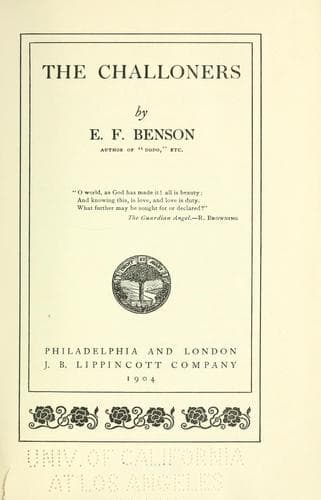
Clergy -- England -- Fiction; England -- Social life and customs -- Fiction; Families -- England -- Fiction
But this morning it seemed to have brought to Helen nothing of the kind,
but only a rested and more active doubt as to whether any of the things
that filled her day could possibly, in the doing, be good for her, or
when done for others. The “Sunday Magazine,” for instance, of which at
this moment she was pasting the torn pages, seemed to her to be
singularly ill adapted to do anything for anybody. There was an essay on
the habits of mice, another on the temptations of engine-drivers;
answers to correspondents dealt with lotions for the hair and the best
treatment for burns; while in the forefront of each number was an
instalment of a serial story connected with incredible ranches and
mining in California. But, in spite of her conscientious doubts, her
fingers moved apace, and the stack of healed and mended volumes at her
right hand grew quickly tall.
She worked on till about twelve without pause, and then pushed back her
chair and began carrying the mended volumes to their shelves. If only
she could have entertained any hopes as to the utility of what she was
doing she would have accepted her occupation with cheerfulness, for her
nature was one of that practical kind which finds almost any pursuit, so
long as it has definite and profitable aim, congenial. This afternoon
again she would have to take choir-practice in the Room, and even with
the eager desire to find “good in everything” she could not see who
profited by the cacophonous result. And to add to her labours, the
ill-inspired ambitions of Mr. Milton had caused him to learn with
infinite pains and groanings of the organ in evening hours nothing less
than an anthem for the Harvest Festival, and it remained for her to
teach the choir. Hours would go to the repetition of it before that
unmelodious festival; and even if it had been possible that relentless
practice could make the choir tolerably secure of their notes (which it
could not), yet the result, even if it were faultlessly performed, would
be deplorable, since it was an anthem of that peculiarly depressing kind
produced by minor organists, contained a fugal passage which was not a
fugue, and, musically speaking, was of the most suburban and jerry-built
construction.
Helen pushed back her hair, and, slightly amused at the greyness of her
own thoughts, smiled to herself as she went backward and forward between
table and bookcase. If only she had some one, another sister, to share
in these farthing woes of a rector’s daughter, she could have laughed
at them; she and a friend, at any rate, could have read each other
striking extracts from the mended leaves of the “Sunday Magazine.” Then
suddenly she heard a step on the gravel outside, a step not her
father’s, but strangely familiar, and the door opened.
“Why, Lord Yorkshire,” she said. “How delightful! Do come in.”
Public-domain text, read in full here on John Shaqi.
Reviews
Reviews
No reviews yet
Be the first to share your thoughts on this work.
Elsewhere in the archive
Join the Discussion
Join the discussion
Sign in to leave a comment or review.
Sign InorCreate an account