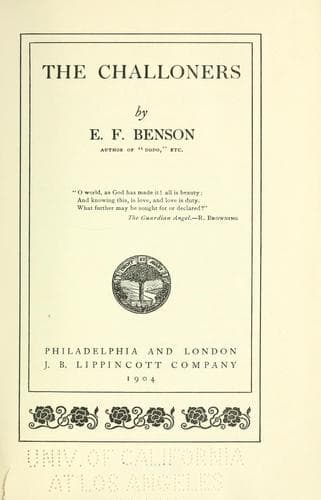
Clergy -- England -- Fiction; England -- Social life and customs -- Fiction; Families -- England -- Fiction
The finality, the sharpness of that click of well-oiled wards, brought
home to the girl, even more than the bitter and burning words which had
been said, what had happened, the unbridgeable breach that had opened
between herself and her father. For, even now, distraught as she was
with the agitation of the scene, so that she felt almost physically
sick, she knew that she had acted in compulsory obedience to an instinct
which was irresistible; she could not call back into her own control the
love she had given. Whatever else beckoned, that to her was the
strongest call. And equally well-known to her was the instinct in
obedience to which her father had acted. Dear as his children were to
him, there was something infinitely dearer, that which from the tower of
the church had pointed upwards into the clear, sunset sky. No assertion
of individualism made its voice heard there; the one immutable love
claimed all allegiances.
Infinitely shocked and distressed as he was, Mr. Challoner did not
suffer during the next half-hour nearly as keenly as Helen, for the idea
that she would not eventually--after pain and struggle, no doubt--see as
he saw never entered his mind. Indeed, after a few minutes the emotion
predominant in him was pity for her at the necessity of the rejection of
the human love offered to and accepted by her. She would be led to the
light--not for a moment did he doubt that--and the suffering would
ennoble and not embitter her. Then, out of pity for her, compunction at
what he had done rose within him. Again he had been harsh and
peremptory; not even the sacred cause he championed could justify that
nor excuse his lack of gentleness. He had left her in anger, anger as he
now acknowledged to himself partly personal in its origin. So, before
half an hour was passed, he unlocked his door, and going upstairs to her
bedroom, tapped softly.
Helen had had no more thought of going to bed than he, and she let him
in at once.
“We did not say good-night, Helen,” he said. “We were both----“
She raised her eyes to him.
“Ah, don’t let us discuss it any more to-night,” she said.
“No, dear. I only wanted to say good-night to you, to--to say that I am
sorry for leaving in the manner I did. You look very tired. Will you not
go to bed.”
“Yes; soon perhaps.”
She kissed him, and stood silent a moment, fingering the lappel of his
coat.
“If we did not care for each other it would be easier,” she said. “Poor
father! Good-night, dear. Thank you for coming.”
* * * * *
It had been arranged that Frank should bring the motor over again next
morning and drive Helen back to Fareham to lunch with Lady Sunningdale,
and he made his appearance rather sooner than expected, having driven,
as he acknowledged, a little over the regulation two miles an hour.
Helen had heard the approach of wheels, and met him at the door. One
glance at her face was enough to tell him that something, and what that
was he easily guessed, had happened.
Public-domain text, read in full here on John Shaqi.
Reviews
Reviews
No reviews yet
Be the first to share your thoughts on this work.
Elsewhere in the archive
Join the Discussion
Join the discussion
Sign in to leave a comment or review.
Sign InorCreate an account