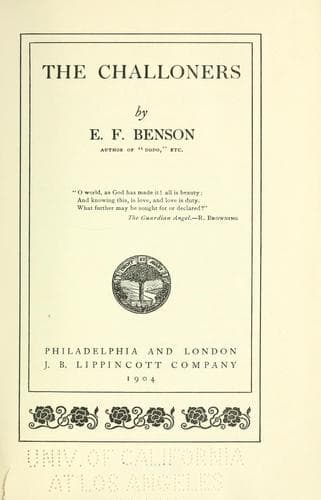
Clergy -- England -- Fiction; England -- Social life and customs -- Fiction; Families -- England -- Fiction
All sorts of awful, impossible situations flapped like horrible bats
about her as she waited. She pictured her father insulting her lover;
she pictured Frank, stung by some intolerable taunt, striking him; she
pictured, with dreadful vividness, a hundred things that could not
possibly be. All round her hummed the myriad noises of the summer noon,
and the myriad scents of the flower-garden, where still the industrious
sweet-peas were prolific, mingled, and were wafted in web of fragrant
smell round her. It was a day of high festival in sound and smell and
light and colour, a day of a brilliance that had again and again been
sufficient to make her half crazy with the pure joy of living and sight
of joyous life so abundantly manifested. But this morning she was deaf
and blind to the myriad-voiced noon; for in these last twenty-four hours
there had come to her a happiness transcending all she had ever felt and
a bitterness of sorrow, marching side by side, and inextricably mingled
with it, that was as immeasurably more poignant than any she had ever
known as her joy transcended all the other joys of her very happy years.
Whatever might happen, life could never again be enjoyed by her with the
_insouciance_ of girlhood: some finger had touched her as she smiled and
dreamed in her twenty years of sleep and had awakened her. And a voice
had said, “Wake; you are a woman; you shall love and suffer.” Yet, even
now, while she shrank and winced under the pain, some secret fibre of
her being welcomed it. She--her essential self--was the richer for it;
life at last had touched her sad, bitter, imperfect, but admirable
life. Like a plant, she had been moved suddenly out of the warm shelter
of a green-house. Hereafter the sun might scorch her, the wind tear her,
the frost wither her, the rain lash her, but she was to know what it was
to be rooted in the great earth, to grow, with no shelter in between,
upward towards the heavens.
All this was certainly happening to her, but as yet she guessed but a
small part of it. All that her reverie, when she had read Lady
Sunningdale’s letter, told her was that she was acutely unhappy because
her father would suffer; and in some tremulous, aërial way happy beyond
all that she had ever guessed to be possible because she loved and was
loved. The two feelings were inextricably intertwined; neither, as she
knew them, could have existence without the other. And out of this
tangled thicket of rose and thorn there emerged this new self of hers,
in no selfish or egoistic mood, but very conscious, very vital, bleeding
from the thorns, but breathing the inimitable odour of the roses.
Public-domain text, read in full here on John Shaqi.
Reviews
Reviews
No reviews yet
Be the first to share your thoughts on this work.
Elsewhere in the archive
Join the Discussion
Join the discussion
Sign in to leave a comment or review.
Sign InorCreate an account