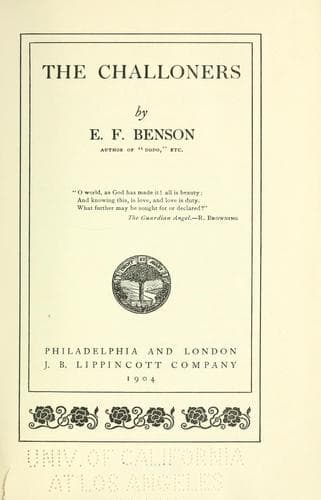
Clergy -- England -- Fiction; England -- Social life and customs -- Fiction; Families -- England -- Fiction
Helen was sitting on a pile of crimson cushions in the stern of a
Canadian canoe, while from the middle of the boat Martin, with
shirt-sleeves rolled up over his brown elbows, paddled her gently along
the reaches of the upper river at Cambridge. The dryness and heat of
this glorious summer had made the river very low in places, and his feet
also were bare, with flannel trousers rolled up to the knee, for again
and again he had to get out to pull the boat round snags or over shoals
where the depth did not allow it to pass with the draught of two
passengers. To the right, across a stretch of meadow stained brown with
length of summer suns, rose the tower of Grantchester church, embowered
in trees, and the booming of the mill sounded drowsily through the still
air. Close to the river, however, a vivider tone of colour prevailed,
tresses of water-side foliage dabbled in the stream, and tall, slender
trees made a shelter from the heat, where cows, a classical example (and
so not appealing to Martin, who splashed water at them) of unbustling
life, chewed the cud and looked with large incurious eyes at the gliding
constellation of the twins. Between them in the boat were packages
containing lunch, for Martin had taken a complete day off his studies in
recalcitrant languages and was devoting himself to Helen, who was
staying with an aunt, Lady Susan Arne. Dr. Arne, her husband, was tutor
at King’s, at which seat of learning Martin pursued his antipathetic
labours, and had the reputation of being the greatest authority living
on the metres of Greek choruses.
Helen had left Chartries a couple of days after the crisis in her
love-affair, at the suggestion of her uncle, to whom she had confided
it.
“I will walk back with you to the vicarage, Helen,” he had said, “and
persuade your father, in case he needs persuasion, to let you go away at
once. Your being with him just now only keeps the wound open. Go away;
it will heal better so. Just now, after that scene, you can only torture
each other by your remaining there. Poor, dear child!”
“Yes; but ‘poor father,’ too,” said Helen.
“Certainly. Come to Chartries, if you like.”
Helen took his arm.
“That is so good of you, Uncle Rupert,” she said; “but I think I should
like to go quite away, if father will let me. I think I should like to
go to Cambridge. Martin is there. And Martin is so good for one, if one
is, well, not very happy.”
“Yes; that is a good plan. You can stay with Susan. My dear, I’m more
sorry for you than I can tell you, and also I am as sorry for your
father. You and I both know him, and we both love him, and, though we
are made very differently, we know how--how splendid he is. And how
big.”
“I know,” said she. “I feel that if I could only persuade myself he was
narrow I should care less. But his huge, singlehearted devotion to--to
God cannot possibly be called narrow.”
They walked on in silence a little.
Public-domain text, read in full here on John Shaqi.
Reviews
Reviews
No reviews yet
Be the first to share your thoughts on this work.
Elsewhere in the archive
Join the Discussion
Join the discussion
Sign in to leave a comment or review.
Sign InorCreate an account