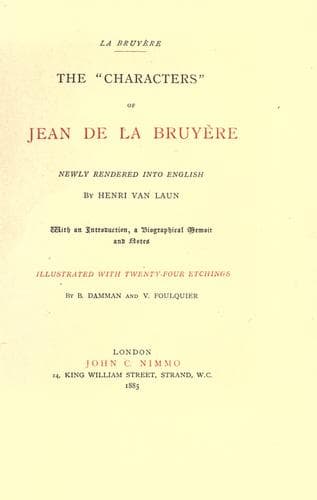
The "Characters" of Jean de La BruyèreLa Bruyère, Jean de
General
The "Characters" of Jean de La Bruyère
La Bruyère, Jean de
Character sketches -- Early works to 1800; Characters and characteristics
(20.) A courtier who has not a pretty name ought to hide it under a
better;[394] but if it is one that he dares own,[395] he should then
insinuate that his name is the most illustrious of all names, and his
house the most ancient of all others; he ought to be descended from the
princes of Lorraine, the Rohans, the Châtillons, the Montmorencys,[396]
and, if possible, from princes of the blood; he ought to talk of
nothing but dukes, cardinals, and ministers; to introduce his
paternal and maternal ancestors in all conversations, as well as the
_Oriflamme_[397] and the Crusades; to have his apartments adorned with
genealogical trees, escutcheons with sixteen quarters, and portraits
of his ancestors and of the relatives of his ancestors; to value
himself on his having an old castle with turrets, battlements, and
portcullises; to be always speaking of his race, his branch, his name,
and his arms; to say of a man that he is not a man of rank, of a woman
that she is not of noble extraction;[398] or to ask whether Hyacinthus
is a nobleman when they tell him he has drawn a great prize in the
lottery.[399] If some persons laugh at such absurd remarks, he lets
them laugh on; if others make erroneous comments, they are welcome; he
will always assert that he takes his place after the royal family, and,
by constantly repeating it, he will finally be believed.
(21.) It shows a simple mind to acknowledge at court the smallest alloy
of common blood, and not to set up for a nobleman.
(22.) At court people go to bed and rise only with a view to self; it
is what they revolve in their own minds morning and evening, night and
day; it is for this they think, speak, are silent or act; it is with
this disposition that they converse with some and neglect others, that
they ascend or descend; by this rule they measure all their assiduity,
complaisance, esteem, indifference, or contempt. Whatever progress any
of them seems to make towards moderation and wisdom, they are carried
away by the first motive of ambition along with the most covetous, the
most violent in their desires, and the most ambitious. Can they stand
still when everything is in motion, when everything is stirring, and
forbear running whither every one runs? Such people even think they
only owe their success in life to themselves; and a man who has not
made it at court is supposed not to have deserved it; and this judgment
is without appeal. However, is it advisable for a man to leave the
court without having obtained any advantage by his stay, or should he
remain there without favour or reward? This question is so intricate,
so delicate, and so difficult to decide, that a very large number of
courtiers have grown old without coming to any affirmative or negative
conclusion, and died, at last, without having arrived at any final
resolution.
Public-domain text, read in full here on John Shaqi.
Reviews
Reviews
No reviews yet
Be the first to share your thoughts on this work.
Elsewhere in the archive
Join the Discussion
Join the discussion
Sign in to leave a comment or review.
Sign InorCreate an account