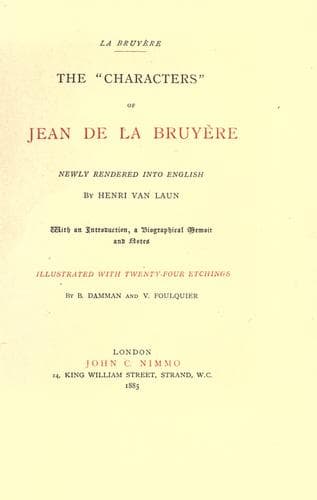
The "Characters" of Jean de La BruyèreLa Bruyère, Jean de
General
The "Characters" of Jean de La Bruyère
La Bruyère, Jean de
Character sketches -- Early works to 1800; Characters and characteristics
(45.) I never yet have seen a courtier whom a prince has appointed
governor of a wealthy province, given a first-rate place, or a large
pension, who does not protest, either through vanity, or to show
himself disinterested, that he is less pleased with the gift than with
the manner in which it was given. What is certain and cannot be doubted
is that he says so.
To give awkwardly denotes the churl; the most difficult and unpleasant
part is to give; then, why not add a smile?
There are, however, some men who refuse with more politeness to grant
you what you ask than others know how to give;[408] and some of whom
it has been said that you have to ask them so long, and they give so
coldly and impose such disagreeable conditions on whatever favour you
have to tear from them, that their greatest favour would be to excuse
us from receiving any.[409]
(46.) There are some men at court so covetous that they catch hold of
any rank or condition to reap its benefits; governments of provinces,
offices, benefices, nothing comes amiss to them; they are so situated
that, by virtue of their official position, they can accept any kind of
favour; they are amphibious, live by the church and the sword, and one
day or other will discover the secret of including the law also.[410]
If you ask what those men do at court, you will be told that they
receive and envy every one to whom anything is given.
(47.) A thousand people at court wear out their very existence by
embracing, caressing, and congratulating all persons who have received
favours, and die without having any bestowed on themselves.
(48.) Menophilus[411] borrows his manners from one profession and his
dress from another; he goes masked all the year, though he does not
conceal his countenance; he appears at court, in town, and elsewhere,
always under a certain name and in the same disguise. He is found out
and known by his face.
(49.) There is a highroad or a beaten road, as it is called, which
leads to grand offices, and there is a cross or bye-way which is much
the shortest.
Public-domain text, read in full here on John Shaqi.
Reviews
Reviews
No reviews yet
Be the first to share your thoughts on this work.
Elsewhere in the archive
Join the Discussion
Join the discussion
Sign in to leave a comment or review.
Sign InorCreate an account