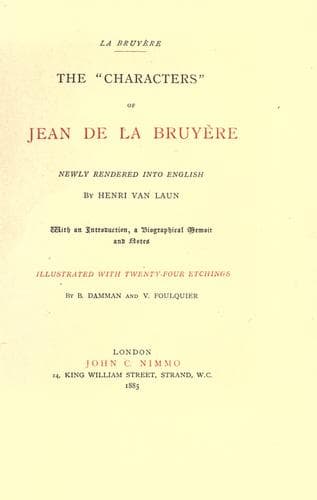
The "Characters" of Jean de La BruyèreLa Bruyère, Jean de
General
The "Characters" of Jean de La Bruyère
La Bruyère, Jean de
Character sketches -- Early works to 1800; Characters and characteristics
(53.) There must be knaves at court[418] about the great and the
Ministers of State, even if those are animated with the best
intentions; but to know when to employ them is a very difficult
question, and requires a certain amount of shrewdness. There are times
and seasons when others cannot fill their places; for honour, virtue,
and conscience, though always worthy of our respect, are frequently
useless, and therefore in certain emergencies an honest man[419] cannot
be employed.
(54.) An ancient author, whose very words I shall take the liberty
to quote,[420] for fear I should weaken the sense of them by my
translation, says: “To forsake the common herd, nay, oneʼs very equals,
to despise and vilify them; to get acquainted with rich men of rank;
to join them in their private amusements, deceits, tricks, and bad
business; to be brazen-faced, shameless, bankrupt in reputation; to
endure the gibes and jokes of all men, and, in spite of all this, not
to fear to go on, and that skilfully, has been the cause of many a
manʼs fortune.”
(55.) The youth of a prince is the making of many courtiers.
(56.) Timantes,[421] still the same, and possessed of that very merit
which at first got him reputation and rewards, has deteriorated in the
opinion of the courtiers, who are weary of respecting him; they bow to
him coldly, forbear smiling on him, no longer accost nor embrace him,
nor take him into a corner to talk mysteriously about some trivial
affair; they have nothing more to say to him. He receives a pension, or
is honoured by being appointed to a new post; and his virtues, almost
dead in their memories, revive whilst their thoughts are refreshed; now
they treat him as they did at the beginning, and even better.
(57.) How many friends, how many relatives of a new Minister, spring
up in a single night! Some men pride themselves on their former
acquaintance, on their having been his fellow-students or neighbours;
others ransack their genealogy, go back to their great-grandfather, and
recall their father and motherʼs side, for in some way or other every
one wishes to be related to him; several times a day people affirm
they are his relatives, and they would even gladly print it. They say
presently: “The Minister is my friend; I am very glad of his promotion,
and I ought to share in it, for he is a near relative of mine.” Would
those silly men, those servile votaries of fortune, those effete
courtiers, have said this a week ago? Has the Minister become a more
virtuous man, or more worthy of his sovereignʼs choice, or were they
waiting for this appointment to know him better?[422]
(58.) What supports me and comforts me when sometimes men of high rank
or my equals slight me, is the feeling that perhaps those very men only
despise my position; and they are quite right, for it is a very humble
one; but they would doubtless worship me if I were a Minister.
Public-domain text, read in full here on John Shaqi.
Reviews
Reviews
No reviews yet
Be the first to share your thoughts on this work.
Elsewhere in the archive
Join the Discussion
Join the discussion
Sign in to leave a comment or review.
Sign InorCreate an account