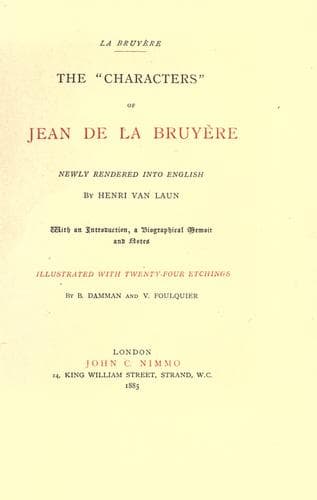
The "Characters" of Jean de La BruyèreLa Bruyère, Jean de
General
The "Characters" of Jean de La Bruyère
La Bruyère, Jean de
Character sketches -- Early works to 1800; Characters and characteristics
Theodotus has a gentler hobby; he immoderately
loves favour, but his passion is less impetuous, and he worships it
secretly, and fosters and serves it mysteriously; he is ever on the
watch to discover who are the new favourites of the king;[428] if these
wish for anything, he offers to serve them, and to intrigue for them;
and stealthily sacrifices to them merit, connections, friendship,
engagements, and gratitude. If the place of Cassini[429] were vacant,
and a Swiss porter or postillion of a favourite were applying for
it, he would support his pretensions, judge him worthy of the place,
and think him capable of making observations and calculations, and
of discussing about parhelions and parallaxes.[430] Should you like
to know whether Theodotus be an author or a plagiary, original or a
copyist, I will give you one of his works, and bid you read and judge.
Who can decide, from the picture I have drawn, whether he is really
pious, or merely a courtier?[431] I can with more assurance proclaim
whether the stars will be propitious to him. Yes, Theodotus, I have
calculated your nativity; you will obtain an appointment, and that
very soon; so abandon your lucubrations, and print no more any of your
writings; the public begs for quarter.
(62.) Never more expect candour, frankness, justice, good offices,
services, kindness, generosity, steadiness from a man who for some time
has spent all his days at court, and secretly wishes to better his
fortunes. Do you know him by his face or conversation? He no longer
calls things by their proper names; for him there exist no longer any
knaves, rogues, fools, or impertinent people; if by chance he
should say of any man what he thinks of him, that very man might come
to know it, and prevent him from getting on.[432] Though he thinks
ill of everybody, he speaks ill of none, for he only wishes success
to himself, but would make believe that he wishes it to everybody, so
that all may assist him, or at least that nobody may oppose him. Not
satisfied with being insincere himself, he cannot endure that any one
should be otherwise; truth offends his ear; he is indifferent, and
does not care what remarks are made about the court and courtiers, but
because he knows what they mean, he fancies himself an accomplice, and
answerable for them. A tyrant in society and a martyr to his ambition,
he is mournfully circumspect in his conduct and in his language; his
raillery is innocent, but cold and constrained; his laughter is forced,
his demonstrations of friendship deceptive, his conversation desultory,
and his absence of mind frequent: he is profuse in his praises, and,
if I may say so, pours out torrents of them whenever any man in office
and a favourite does or says the smallest thing; but for any other
person he is as sparing with his words as if he were consumptive. He
has different formulas for complimenting people on entering or leaving
a room, as well when he visits as when he is visited, and none of those
Public-domain text, read in full here on John Shaqi.
Reviews
Reviews
No reviews yet
Be the first to share your thoughts on this work.
Elsewhere in the archive
Join the Discussion
Join the discussion
Sign in to leave a comment or review.
Sign InorCreate an account