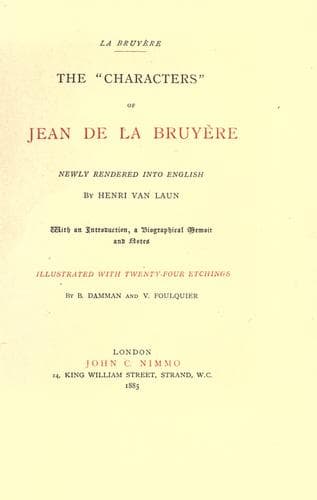
The "Characters" of Jean de La BruyèreLa Bruyère, Jean de
General
The "Characters" of Jean de La Bruyère
La Bruyère, Jean de
Character sketches -- Early works to 1800; Characters and characteristics
(77.) What is there wanting in the youth of the present time? They can
do and they know everything; or at least if they do not know as much as
it is possible to know, they are as positive as if they did.
(78.) How weak are men! A great lord says of your friend Timagenes
that he is a blockhead, but he makes a mistake. I do not require you to
reply that Timagenes is a clever man, but only dare think he is not a
blockhead.
He says also that Iphicrates is a coward; and you have seen him perform
an act of bravery. But do not be uneasy. I do not insist you should
relate it, but, after what you have heard this lord say, still remember
that you saw him perform it.
(79.) To know how to speak to a king is perhaps the sole art of a
prudent and pliant courtier. One word escapes him, which the prince
hears, recollects, and sometimes lodges in his heart; there is no
recalling it; all the care and skill that can be used to explain or
soften it, serves only to impress it the more and to bite it in deeper.
If the courtier has only spoken against himself, though this misfortune
is very unusual, the remedy is at hand; he must take warning by his
fault, and bear the punishment of his levity; but if another be the
victim, he ought to feel dejected and contrite. Is there a better
rule in such a dangerous conjuncture than to talk to our sovereign
of others, of their persons, works, actions, manners, or conduct, at
least with the same reserve, precaution, and care with which we talk of
ourselves?
(80.) I would say that a man who tries to be witty must have a most
wretched character, if it had not been said before.[443] Those persons
who injure the reputation or position of others for the sake of a
witticism deserve to be punished with ignominy; this has not been said
before, and I dare say it.
(81.) There are a certain number of ready-made phrases which we store
and use when we wish to congratulate one another. Though we often utter
them without really feeling what we say, and are received without
gratitude, yet we must not omit them, because, at least, they represent
the very best thing in this world, namely, friendship; and since men
cannot depend on one another in reality, they seem to have agreed to be
satisfied with appearances.
(82.) With five or six terms of art, and nothing else, we set up for
connoisseurs in music, painting, architecture, and gastronomy; we fancy
we have more pleasure than others in hearing, seeing, or eating; we
impose on our fellow-creatures and deceive ourselves.
Public-domain text, read in full here on John Shaqi.
Reviews
Reviews
No reviews yet
Be the first to share your thoughts on this work.
Elsewhere in the archive
Join the Discussion
Join the discussion
Sign in to leave a comment or review.
Sign InorCreate an account