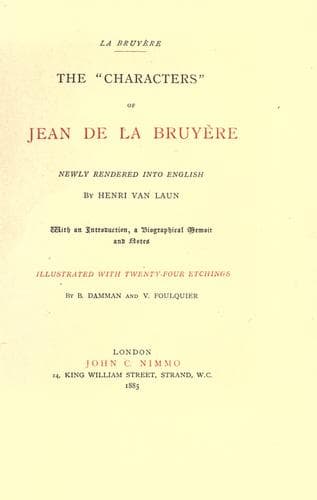
The "Characters" of Jean de La BruyèreLa Bruyère, Jean de
General
The "Characters" of Jean de La Bruyère
La Bruyère, Jean de
Character sketches -- Early works to 1800; Characters and characteristics
(87.) Methinks a man who solicits for others shows the confidence of a
person asking for justice, whilst he who speaks or acts for himself is
as embarrassed and bashful as if he were asking a favour.
(88.) If a courtier be not continually upon his guard against the
snares laid for him to make him ridiculous, he will, with all
his sagacity, be amazed to find himself duped by people far less
intelligent than he is.
(89.) In life some circumstances may happen when truth and simplicity
prove the best policy.
(90.) If you are in favour, whatever you do is well done; you commit no
faults, and every step you take leads you to the goal; but if you are
not in favour, everything you do is faulty and useless, and whatever
path you take leads you out of the way.
(91.) A man who has schemed for some time can no longer do without it;
all other ways of living are to him dull and insipid.
(92.) Intelligence is requisite to be a schemer; yet a man may have a
sufficient amount of it to be above scheming and plotting, and above
subjecting himself to such things; in such a case he takes other means
for bettering his fortune, or for acquiring a brilliant reputation.
(93.) Fear not, O Aristides, with your sublime intellect, your
universal learning, your well-tried honesty, and your highly
accomplished merits, to fall into disgrace at court, or to lose the
favour of men of high rank so long as they need you.[446]
(94.) Let a favourite watch his actions very narrowly; for if I have to
wait in his anteroom not so long as usual; if his countenance be more
open, his forehead less clouded; if he listens to me more patiently,
and sees me to the door a little farther than he used to do, I shall
think he is tottering, and shall not be mistaken.
Man has but very little strength of mind, for disgrace or
mortifications are needed to make him more humane, pliable, less rude,
and more of a gentleman.
(95.) If we observe certain people at court, their discourses and their
whole conduct show that they think neither of their grandfathers nor
grandchildren; they only care for the present, and that they do not
enjoy, but abuse.
Public-domain text, read in full here on John Shaqi.
Reviews
Reviews
No reviews yet
Be the first to share your thoughts on this work.
Elsewhere in the archive
Join the Discussion
Join the discussion
Sign in to leave a comment or review.
Sign InorCreate an account