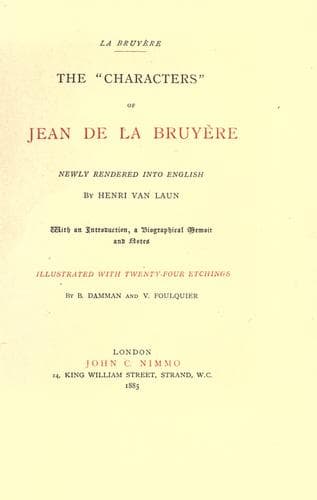
The "Characters" of Jean de La BruyèreLa Bruyère, Jean de
General
The "Characters" of Jean de La Bruyère
La Bruyère, Jean de
Character sketches -- Early works to 1800; Characters and characteristics
(2.) If you are intrinsically vicious, O Theagenes[449] I pity you;
if you have become so out of weakness for those men who have an
interest in your being debauched, who have conspired to corrupt you,
and boast already of their success, you will excuse me if I despise
you. But if you are wise, temperate, modest, polite, generous,
grateful, industrious, and besides of a birth and rank which ought to
set examples rather than copy those others give, and to make rules
rather than to receive them, agree with such a class of men, and be
complaisant enough to imitate their disorders, vices, and follies,
after the respect they owe you has obliged them to imitate your
virtues. This is a bitter but useful ironical remark, very suitable
for securing your morals, for ruining all their projects, and for
compelling them to remain as they are, and leave you as you are.
(3.) In one thing great men have an immense advantage over others; they
may enjoy their sumptuous banquets, their costly furniture, their dogs,
horses, monkeys, dwarfs, fools, and flatterers; but I envy them the
happiness of having in their service their equals, and sometimes even
their superiors, in feelings and intelligence.
(4.) Great lords delight in opening glades in forests, in raising
terraces on long and solid foundations, in gilding their ceilings, in
bringing a good deal of water where there was none before, in growing
oranges in hothouses; but they are not anxious to restore peace to
the distracted, to make joyful the afflicted, and to forestall urgent
necessities, or to relieve them.
(5.) The question arises, whether, in comparing the different
conditions of men, their troubles and advantages, we cannot observe
such a mixture or balance of good and evil as seems to place them on
an equality, or at least as makes one scarcely more desirable than
another. Those men who are powerful, rich, and who want nothing may put
the question, but the decision must be left to the indigent.
There is, however, a kind of charm belonging to each of those different
conditions, and which lasts till misery removes it. The great please
themselves in excess, their inferiors in moderation: these delight in
lording and commanding; those are pleased, and even proud, to serve and
to obey: the great are surrounded, complimented, and respected; the
little surround, compliment, and cringe; and both are satisfied.
(6.) Good words cost the great so little, and their rank gives them
such a dispensation for not keeping what they have most solemnly
promised, that they really are moderate in being so sparing of those
promises.
(7.) “Such a person,” says some great man, “has grown old and feeble,
and has worn himself out in my service. What can I do for him?” A
younger competitor steps in, and obtains the post which had been
refused to this unfortunate man for no other reason but that he too
well deserved it.
Public-domain text, read in full here on John Shaqi.
Reviews
Reviews
No reviews yet
Be the first to share your thoughts on this work.
Elsewhere in the archive
Join the Discussion
Join the discussion
Sign in to leave a comment or review.
Sign InorCreate an account