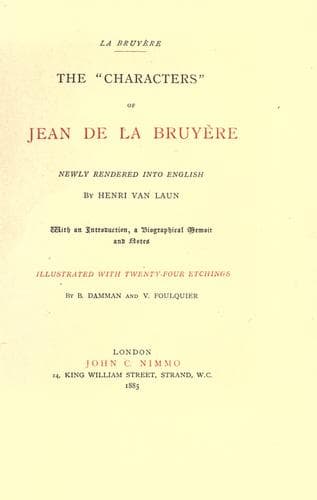
The "Characters" of Jean de La BruyèreLa Bruyère, Jean de
General
The "Characters" of Jean de La Bruyère
La Bruyère, Jean de
Character sketches -- Early works to 1800; Characters and characteristics
(53.) The same passions, the same weaknesses, the same meannesses, the
same eccentricities, the same quarrels in families and among relatives,
the same jealousies and antipathies prevail at court and in town.[485]
You find everywhere daughters-in-law, mothers-in-law, husbands
and wives; divorces, separations, and patched-up reconciliations;
everywhere fancies, fits of passion, partialities, tittle-tattle, and
what is called evil-talking. An observer would easily imagine that the
inhabitants of a small town or of the Rue Saint-Denis were transported
to V ... or to F....[486] In these two last places people display,
perhaps, more pride, haughtiness, and perhaps more decorum in hating
one another; they injure one another with more skill and refinement;
their outbursts of rage are more eloquent, and they insult one another
with more politeness and in a more select phraseology; they do not
defile the purity of the language, they only offend men or blast their
reputations; the outside of vice is handsome, but in reality, I say it
again, it is the same as in the most abject conditions, for whatever is
base, weak, and worthless is found there. These men so eminent by their
birth, by favour, or by their position, these minds so powerful and so
sagacious, these women so polished and so witty, are themselves but
common people, though they despise common people.
The words “common people” include several things; they are a
comprehensive expression, and we may be surprised to see what they
contain and how far they extend. The common people, in opposition to
the great, signify the mob and the multitude; but, as opposed to wise,
able, and virtuous men, they include the great as well as the little.
(54.) The great are governed by sensations; their minds are unoccupied,
and everything makes immediately a strong impression on them. If
anything happens, they talk about it too much; soon after they talk
about it but little, and then not at all, nor ever will; actions,
conduct, execution, incidents are all forgotten; expect from them
neither amendment, foresight, reflection, gratitude, nor reward.
(55.) We are led to two opposite extremes with regard to certain
persons. After their death satires about them are current among the
people, while the churches re-echo with their praises. Sometimes they
deserve neither those libels nor these funeral orations, and sometimes
both.
(56.) The less we talk of the great and powerful the better; if we say
any good of them, it is often almost flattery; it is dangerous to speak
ill of them whilst they are alive, and cowardly when they are dead.
[Illustration]
X.
OF THE SOVEREIGN AND THE STATE.[487]
(1.) When we have cursorily examined all forms of government without
partiality to the one of our fatherland, we cannot decide which to
choose; they are all a mixture of good and evil; it is, therefore, most
reasonable to value that of our native land above all others, and to
submit to it.
Public-domain text, read in full here on John Shaqi.
Reviews
Reviews
No reviews yet
Be the first to share your thoughts on this work.
Elsewhere in the archive
Join the Discussion
Join the discussion
Sign in to leave a comment or review.
Sign InorCreate an account