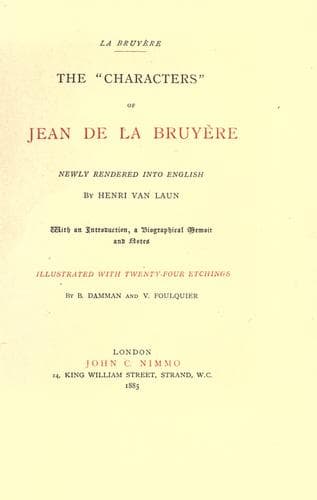
The "Characters" of Jean de La BruyèreLa Bruyère, Jean de
General
The "Characters" of Jean de La Bruyère
La Bruyère, Jean de
Character sketches -- Early works to 1800; Characters and characteristics
(25.) Eight or ten thousand men are to a prince like money; with
their lives he buys a town or a victory; but, if he can obtain either
at a cheaper rate, and is sparing of them, he is like a man who is
bargaining and knows better than any other the value of money.
(26.) All things succeed in a monarchy where the interests of the state
are identical with those of the prince.
(27.) To call a king the father of his people[519] is not so much to
eulogise him as to call him by his name and to define what he is.
(28.) There exists a sort of interchange or permutation of duties
between a sovereign and his subjects, and between them and him; and
I shall not decide which are most obligatory and most difficult. On
the one hand, we have to determine what are the bounden duties of
reverence, assistance, service, obedience, and dependence, and on the
other what are the indispensable obligations of goodness, justice, and
protection. To say the prince can dispose of the lives of the people,
is to tell us only that through their crimes men have become subjected
to the laws and justice which the king administers; to add that he is
absolute master of all his subjectsʼ goods without any considerations,
without rendering any accounts, or without discussion, is the language
of flattery, the opinion of a favourite who will recant on his
deathbed.[520]
(29.) When on a fine evening a numerous flock of sheep is seen on a
hill quietly browsing thyme and wild thyme, or nibbling in a meadow
the short and tender grass which has escaped the scythe of the reaper,
the careful and diligent shepherd is amongst them; he does not lose
sight of them, but follows them, leads them, changes their pasture;
if they wander, he calls them together; if a hungry wolf approaches,
he sets his dog on to beat him off; he keeps them and defends them;
and when the sun rises he is already in the fields, which he leaves at
its setting. What an amount of care, watchfulness, and assiduity is
needed! Which condition seems to you the most delicious and the most
unfettered, that of the sheep or of the shepherd? Was the flock made
for the shepherd or the shepherd for the flock? This is an artless
representation of a nation and its prince, but then the prince must be
good.
A gorgeous and sumptuous monarch is like a shepherd adorned with
gold and jewels, with a golden crook in his hands, with a collar of
gold about his dogʼs neck, and a silken and golden string to lead him.
What is his flock the better for all this gold, or what avails it
against the wolves?
(30.) How happy is that station which every instant furnishes
opportunities of doing good to thousands of men! how dangerous is that
post which every moment exposes its occupant to injure millions!
(31.) If men in this world cannot feel a more natural, praiseworthy,
and sensible pleasure than to know that they are beloved, and if kings
are men, can they purchase the hearts of their people at too high a
rate?
Public-domain text, read in full here on John Shaqi.
Reviews
Reviews
No reviews yet
Be the first to share your thoughts on this work.
Elsewhere in the archive
Join the Discussion
Join the discussion
Sign in to leave a comment or review.
Sign InorCreate an account