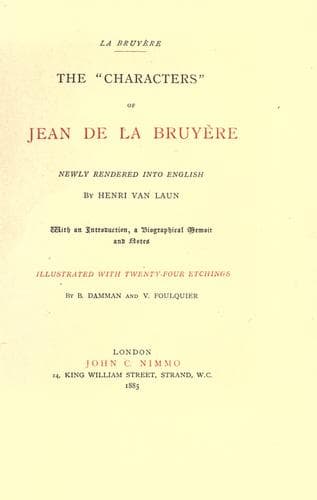
The "Characters" of Jean de La BruyèreLa Bruyère, Jean de
General
The "Characters" of Jean de La Bruyère
La Bruyère, Jean de
Character sketches -- Early works to 1800; Characters and characteristics
(78.) Those who, by violence or injustice, steal our property, or
rob us of our honour by slander, show effectually that they hate us;
but this is not an undoubted proof that they no longer esteem us;
therefore, it is not impossible that we may forgive them, and, one day
or other, again become their friends. Ridicule, on the contrary, is of
all wrongs the least to be excused, for it is the language of contempt,
and one of the ways in which it is most plainly expressed; it attacks
a man in his last intrenchment, namely, the good opinion he has of
himself; it aims at making him ridiculous in his own eyes; and thus
convinces him that the person who ridicules him is very badly disposed
towards him, so that he resolves never to be reconciled to him.
It is monstrous to consider how easy it is for us to ridicule, censure,
and despise others, and how we enjoy it; and yet how enraged we are
when others ridicule, censure, and despise us.
(79.) Health and wealth prevent men from experiencing misfortunes, and
thus make them callous to their suffering fellow-creatures; whilst they
who already are burdened by their own miseries feel most tenderly those
of others.
(80.) In well-constituted minds,[557] festivals, spectacles, and music
bring more vividly before us, and make us feel the more the misfortunes
of our relatives or friends.
(81.) A great mind is above insults, injustice, grief, and raillery,
and would be invulnerable were it not open to compassion.
(82.) We feel somewhat ashamed of being happy at the sight of certain
miseries.
(83.) Men have a very quick perception of their smallest advantages and
are as backward in discovering their faults. They never ignore they
have fine eyebrows and well-shaped nails, but scarcely know they have
lost an eye, and not at all when they are wanting in understanding.
Argyra pulls off her glove to show her fine hand, and does not forget
to let us have a peep of her little shoe, which makes us think she has
a small foot; she laughs at serious as well as at funny observations to
show her fine teeth; if she does not hide her ears it is because they
are well shaped; and if she does not dance, it is because she is not
too well satisfied with her waist, which is not very slender. She knows
perfectly well what she is about, with the exception of one thing: she
is always talking, and has not one grain of sense.
(84.) Men do not value very highly the affections of the heart, but
idolise the gifts of body and mind. A person who, in speaking of
himself, would coolly say that he is good, constant, faithful, sincere,
just, and grateful, does not imagine he offends against modesty; but
he would not venture to say that he is sprightly, or that he has fine
teeth or a soft skin; that would be rather too much of a good thing.
Public-domain text, read in full here on John Shaqi.
Reviews
Reviews
No reviews yet
Be the first to share your thoughts on this work.
Elsewhere in the archive
Join the Discussion
Join the discussion
Sign in to leave a comment or review.
Sign InorCreate an account