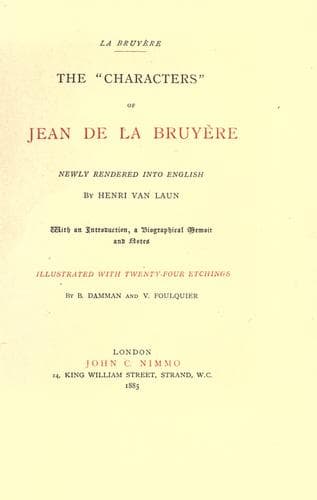
The "Characters" of Jean de La BruyèreLa Bruyère, Jean de
General
The "Characters" of Jean de La Bruyère
La Bruyère, Jean de
Character sketches -- Early works to 1800; Characters and characteristics
(135.) When I contemplate the fortune of princes and of their
Ministers, which is not mine, I am prevented from thinking myself
unhappy by considering, at the same time, the fate of the vine-dresser,
the soldier, and the stone-cutter.
(136.) There is but one real misfortune which can befall a man, and
that is to find himself at fault, and to have something to reproach
himself with.
(137.) The generality of men are more capable of great efforts to
obtain their ends than of continuous perseverance; their occupation
and inconstancy deprives them of the fruits of the most promising
beginnings; they are often overtaken by those who started some time
after them, and who walk slowly but without intermission.
(138.) I almost dare affirm that men know better how to plan certain
measures than to pursue them, how to resolve what they must needs
do and say than to do or to say what is necessary. A man is firmly
determined not to mention a certain subject when negotiating some
business; and afterwards, either through passion, garrulity, or in the
heat of conversation, it is the first thing which escapes him.
(139.) Men are indolent in what is their particular duty, whilst they
think it very deserving, or rather whilst it pleases their vanity, to
busy themselves about those things which do not concern them, nor suit
their condition of life or character.
(140.) There is as much difference between a heterogeneous character
a man adopts and his real character as there is between a mask and a
countenance of flesh and blood.
(141.) Telephus has some intelligence, but ten times less, if rightly
computed, than he imagines he has; therefore, in everything he says,
does, meditates, and projects, he goes ten times beyond his capacity,
and thus always exceeds the true measure of his intellectual power and
grasp. And this argument is well founded. He is limited by a barrier,
as it were, and should be warned not to pass it; but he leaps over
it, launches out of his sphere, and though he knows his own weakness,
always displays it; he speaks about what he does not understand, or
badly understands; attempts things above his power, and aims at what
is too much for him; he thinks himself the equal of the very best men
ever seen. Whatever is good and commendable in him is obscured by an
affectation of doing something great and wonderful; people can easily
see what he is not, but have to guess what he really is. He is a man
who never measures his ability, and does not know himself; his true
character is not to be satisfied with the one that suits him, and which
is his own.
(142.) The intelligence of a highly cultivated man is not always the
same, and has its ebbs and flows; sometimes he is full of animation,
but cannot keep it up; then, if he be wise, he will say little, not
write at all, and not endeavour either to draw upon his imagination, or
try to please. Does a man sing who has a cold? and should he not rather
wait till he recovers his voice?
Public-domain text, read in full here on John Shaqi.
Reviews
Reviews
No reviews yet
Be the first to share your thoughts on this work.
Elsewhere in the archive
Join the Discussion
Join the discussion
Sign in to leave a comment or review.
Sign InorCreate an account