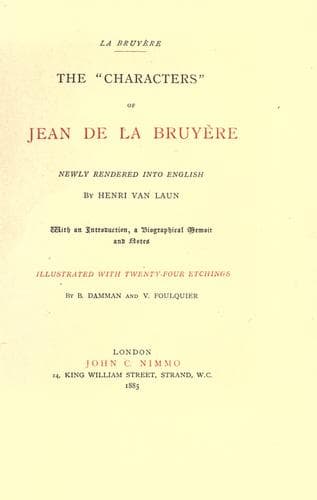
The "Characters" of Jean de La BruyèreLa Bruyère, Jean de
General
The "Characters" of Jean de La Bruyère
La Bruyère, Jean de
Character sketches -- Early works to 1800; Characters and characteristics
Only
one among them, ever kind-hearted and magnanimous, opens his arms
to receive an unhappy family;[674] all the others league themselves
against him as if to avenge the assistance he lends to a cause which
is theirs as well; spite and jealousy have more weight with them than
considerations for their honour, religion, and rule, and even than
domestic and personal interests; they do not perceive that, I will
not say their election, but their very succession, and even their
hereditary rights are at stake. Finally, in every one of them personal
feelings prevail over those of a sovereign. One prince was going to
set Europe free, and free himself as well from an ominous enemy; he was
just on the point of reaping the glory of having destroyed a mighty
empire when he abandoned his plan, and joined in a war in which success
is far from certain.[675] Those rulers who by virtue of their position
are arbitrators and mediators temporise; and when they could already
have interfered and done some good, they only promise they will do
so.[676] “O shepherds,” continues Heraclitus, “O ye rustics who dwell
in hovels and cottages; if the course of events does not affect you, if
your hearts are not pierced by the malice of men, if man is no longer
mentioned among you, but foxes and lynxes are the only subjects of your
conversation, allow me to dwell with you, to appease my hunger with
your black bread, and to quench my thirst with the water from your
wells.”
[Illustration: WILLIAM III]
(119.) Ye little men, only six feet high, or at most seven, who, as
soon as you have reached eight feet, are to be seen for money in
booths at the fairs, as giants and wonders; who, without blushing,
give yourselves the titles of “highnesses” and “eminences,” which
is the utmost that can be granted to those mountain-tops so near
the sky that they see the clouds form underneath them; ye haughty,
vain-glorious animals who despise all other creatures, and who cannot
even be compared to an elephant or a whale, draw near, ye men, and
answer Democritus. Do you not commonly speak of “hungry wolves,
furious lions, and mischievous monkeys?” Pray, who are you? “Man is
a rational creature” is continually dinned in my ears. Who gave you
this appellation? Did the wolves, or the lions, or the monkeys do so,
or did you take it yourselves? It is already very ridiculous that you
should bestow on animals, your fellow-creatures, all the bad epithets,
and take the best for yourselves; leave it to them to give names, and
you will see that they will not forget themselves, and how you will
be treated. I do not mention, O men, your frivolities, your follies
and caprices, which place you lower than the mole or the tortoise,
who wisely move along quietly and follow invariably their own natural
instinct; but listen to me for a moment: You say of a goshawk if it be
very swift-winged and swoops well down on a partridge, that it is a
good bird; of a greyhound following a hare very close and catching it,
Public-domain text, read in full here on John Shaqi.
Reviews
Reviews
No reviews yet
Be the first to share your thoughts on this work.
Elsewhere in the archive
Join the Discussion
Join the discussion
Sign in to leave a comment or review.
Sign InorCreate an account