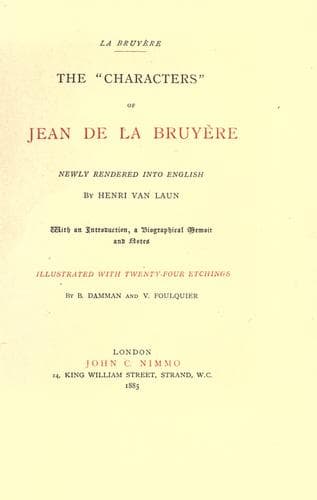
The "Characters" of Jean de La BruyèreLa Bruyère, Jean de
General
The "Characters" of Jean de La Bruyère
La Bruyère, Jean de
Character sketches -- Early works to 1800; Characters and characteristics
(23.) When a courtier shall be humble, divested of pride and ambition,
cease to advance his own interests by ruining his rivals, be just and
relieve the misery of his vassals, pay his creditors, be neither a
knave nor a slanderer, shall abandon luxurious feasting and unlawful
amours, pray not only with his lips, and even when the prince is not
present, shall not be morose and inaccessible, not show an austere
countenance and a sour mien, shall not be lazy and buried in thought,
reconcile a multiplicity of employments by conscientious application,
shall be able and willing to devote his whole mind and all his
attention to those great and arduous affairs which especially concern
the welfare of the people and of the entire state; when his character
shall make me afraid of mentioning him in this paragraph, and his
modesty prevent him from knowing himself, if I should not give his
name; then I shall say of such a man that he is devout, or rather that
he is a man given to this age as an example of sincere virtue as well
as to detect hypocrites.[726]
(24.) Onuphriusʼ bed[727] has only grey serge valances, but he sleeps
on flock and down; he also wears plain but comfortable clothes, I mean,
made of a light material in summer, and of very soft cloth in winter;
his body-linen is very fine, but he takes very good care not to show
it; he does not call out for his “hair-shirt and scourge,”[728] for
then he would show himself in his true colours, as a hypocrite, whilst
he intends to pass for what he is not, for a religious man; however,
he acts in such a way that people believe, without his telling it
them, that he wears a hair-shirt and scourges himself. Several books
lie about his apartments, such as the “Spiritual Fight,” the “Inward
Christian,” the “Holy Year;”[729] his other books are under lock and
key; if he goes along the streets and perceives from afar a man to whom
he ought to seem devout, downcast looks, a slow and demure gait, and a
contemplative air are at his command; he plays his part. If he enters
a church, he observes whose eyes are upon him, and accordingly kneels
down and prays, or else, never thinks of kneeling down and praying; if
he sees an honest man and a man of authority approach him, by whom he
is sure to be perceived, and who, perhaps, may hear him, he not only
prays but meditates, has outbursts of devotion, and sighs aloud; but as
soon as this honest man is gone, he becomes calm, and does not say a
single word more. Another time he enters a chapel, rushes through the
crowd, and chooses a spot to commune with himself, and where everybody
may see how he humbles himself;[730] if he hears any courtiers speaking
or laughing loud, and behave in chapel more boisterously than they
would in an ante-chamber,[731] he makes a greater noise than they
to silence them, and returns to his meditations, in which he always
disdainfully compares those persons to himself, to his own advantage.
Public-domain text, read in full here on John Shaqi.
Reviews
Reviews
No reviews yet
Be the first to share your thoughts on this work.
Elsewhere in the archive
Join the Discussion
Join the discussion
Sign in to leave a comment or review.
Sign InorCreate an account