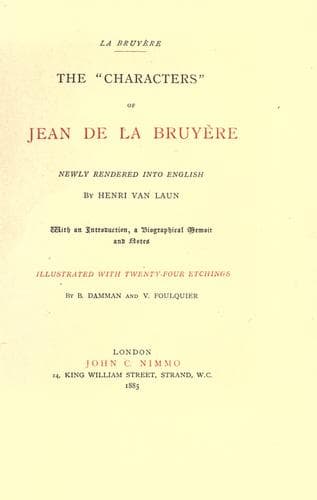
The "Characters" of Jean de La BruyèreLa Bruyère, Jean de
General
The "Characters" of Jean de La Bruyère
La Bruyère, Jean de
Character sketches -- Early works to 1800; Characters and characteristics
Moreover, those women who improve and thrive under the shelter of
piety[736] suit him, but with this trifling difference, that he
neglects those who are declining in years, and courts the young, and
amongst these is only attracted by the best looking and the finest
shape; he goes where they go, and returns when they return, and if they
stay anywhere he stays there also; he has the consolation of seeing
them at all times and places, and nobody needs be shocked about this,
for they are devout, and so is he. Onuphrius is sure to make the best
use he can of his friendʼs cecity and of his prepossession; sometimes
he borrows money of him; at other times he acts so artfully that his
friend offers to lend him some; people are very angry with him because
he does not apply to his other friends when he needs money; now and
then he refuses to receive a small sum unless he gives his note of hand
for it, though he is quite certain never to take it up; at another time
he says, with a certain air, he is not in want of anything, and that
is, when he only needs a trifling amount; and on a certain occasion he
publicly extols the generosity of his friend, on purpose to induce him
to give him a considerable sum. He does not expect to succeed to the
whole of the real estate of his friend, nor to get a deed of gift of
all his property, especially if the son, the right and lawful heir, has
to be set aside.[737] A pious man is neither a miser, nor prejudiced,
unjust, nor selfish; and, though Onuphrius is not a pious man, he
wishes to be thought one, and perfectly to imitate piety, though he
does not feel it, in order secretly to forward his interests; he,
therefore, would never aim at robbing the direct heirs of any family,
nor insinuate himself where there is a daughter to portion, and a son
to establish;[738] he knows their rights are too strong and inviolable
to be upset without loud clamours, which he dreads, and without such
an undertaking coming to the ears of the prince,[739] from whom he
conceals his intrigues for fear of his true character being discovered.
He selects collateral heirs, whom he can attack with greater impunity,
and is the terror of male and female cousins, nephews and nieces, and
of the flatterers and professed friends of all rich uncles; he gives
himself out to be the legitimate heir of every wealthy old man who dies
without issue, and who will have to disinherit him, if he wishes his
relatives to get possession of his estate. If Onuphrius does not find
means[740] to deprive them of the whole, he will, at least, rob them of
a good share of it; a trifling calumny or even the slightest slander
are sufficient for this pious purpose, and, indeed, Onuphrius is a
perfect master of the art of slandering, and considers it sometimes
his duty not to let it lie dormant, for there are men and women whom,
according to him, he must decry for conscienceʼ sake; and these are
the people he does not like, whom he wishes to harm, and whose spoils
Public-domain text, read in full here on John Shaqi.
Reviews
Reviews
No reviews yet
Be the first to share your thoughts on this work.
Elsewhere in the archive
Join the Discussion
Join the discussion
Sign in to leave a comment or review.
Sign InorCreate an account