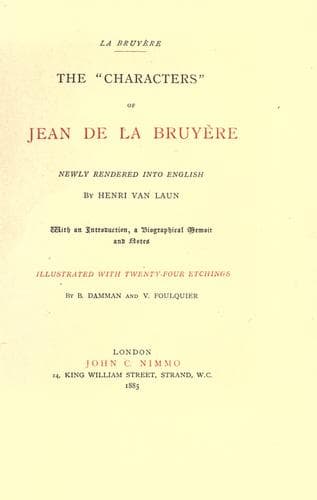
The "Characters" of Jean de La BruyèreLa Bruyère, Jean de
General
The "Characters" of Jean de La Bruyère
La Bruyère, Jean de
Character sketches -- Early works to 1800; Characters and characteristics
(30.) A certain man gambles and is ruined, but nevertheless, when the
eldest of his two daughters gets married, he gives her as a dowry all
he has been able to rescue out of the clutches of some cheat;[770] the
younger will shortly become a nun, without any vocation for it, but
compelled by the losses of her father at play.
(31.) Certain maidens, virtuous, healthy, enthusiasts in religion, and
who feel they have a call, have not sufficient money to enter a wealthy
nunnery and to take the vows of poverty.
(32.) A woman who hesitates whether she shall enter an abbey or a
nunnery revives the old question about the advantages of a popular or a
despotic rule.[771]
(33.) To play the fool and marry for love is to marry Melita, a
handsome, sensible, thrifty, charming young woman who loves you, but is
not so wealthy as Ægina, whose hand is proposed to you, with a large
dowry, but who feels a strong inclination for spending it all, and your
own fortune as well.
(34.) Formerly it was considered no trifling affair to get married;
it was a settlement for life, a matter of importance which deserved a
great deal of consideration; for a man had to take a wife for all his
life, for better or worse; the same table and the same bed served them
both; there was no getting rid of one another by separate maintenance,
and a man with a household and children did not seem a rollicking
bachelor.
(35.) I commend the bashfulness of a man who avoids being seen with
a woman not his wife, and I can also understand his being loth to
frequent persons of bad reputation. But what an impertinence for a man
to blush being in the company of his own wife and being ashamed of
appearing in public with a lady whom he has chosen as his companion
for life, who should be his joy, his comfort, and his chief society;
whom he loves and esteems, who adorns his home, and whose intelligence,
merits, virtue, and connections reflect credit on him. Why did he not
begin being ashamed of his marriage?
I am well aware of the tyranny, of custom, how it sways the mind and
constrains the manners of men, even in things which are most senseless
and needless; but I feel, nevertheless, I could be bold enough to walk
on the Cours to be stared at in the company of the lady who is my
wife.[772]
Public-domain text, read in full here on John Shaqi.
Reviews
Reviews
No reviews yet
Be the first to share your thoughts on this work.
Elsewhere in the archive
Join the Discussion
Join the discussion
Sign in to leave a comment or review.
Sign InorCreate an account