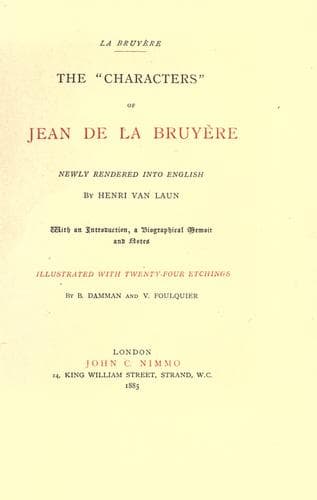
The "Characters" of Jean de La BruyèreLa Bruyère, Jean de
General
The "Characters" of Jean de La Bruyère
La Bruyère, Jean de
Character sketches -- Early works to 1800; Characters and characteristics
(26.) The eloquence of the pulpit, with respect to what is merely human
and depending on the genius of the orator, is not easily perceptible,
is known but to few, and attained with difficulty. It must be very
difficult to please and to persuade at the same time; for a man is
obliged to keep to beaten paths, to say what has been said, and what
is foreseen he would say. The subjects he has to treat of are grand,
but worn and trite; the principles are invariable, but every one of
his audience perceives the inferences at the first glance. Some of
the subjects are sublime; but who can treat of the sublime? There are
mysteries to be explained, but they are better explained in a lecture
at college than in a harangue. The morals, too, of the pulpit, though
they comprehend matter as vast and diversified as the manners and
morals of men, turn all upon the same pivot, exhibit the same imagery,
and are restrained to much narrower limits than satire is; after the
usual invective against honour, riches, and pleasures, there remains
nothing more for the orator to do but to finish his discourse and
dismiss his audience. There may sometimes be tears, and people may be
moved; but let the calling and talent of the preacher be considered,
and perhaps it will be found that the subject lends itself to a sermon,
or that it is chiefly a feeling of self-interest which produces this
agitation; and that it is not so much true eloquence as the strong
lungs of the missionary which shake us and produce within us these
emotions. In short, the preacher is not provided, as the lawyer is,
with always fresh matters of fact, with various transactions and
unheard-of adventures; his business is not to start doubtful questions,
and improve probable conjectures—all subjects which elevate talent,
give it force and breadth, and instead of putting a restraint on
eloquence, only fix and direct it. The preacher, on the contrary, has
to draw his discourse from a source known to all and used by everybody;
if he deviates from these commonplaces, he ceases to be popular,
becomes abstruse and a declaimer, and no longer preaches the Gospel.
All he needs is a noble simplicity, which is difficult to attain,
rarely found, and above the reach of ordinary men; their talent,
imagination, learning, and memory, so far from assisting them, often
prevent their acquiring it.
Public-domain text, read in full here on John Shaqi.
Reviews
Reviews
No reviews yet
Be the first to share your thoughts on this work.
Elsewhere in the archive
Join the Discussion
Join the discussion
Sign in to leave a comment or review.
Sign InorCreate an account