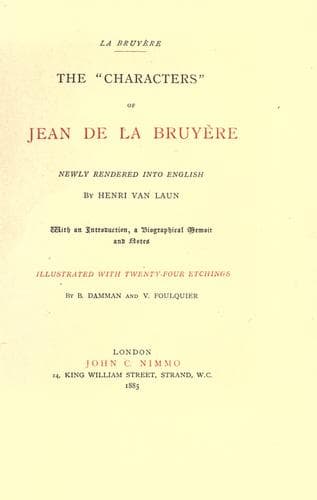
The "Characters" of Jean de La BruyèreLa Bruyère, Jean de
General
The "Characters" of Jean de La Bruyère
La Bruyère, Jean de
Character sketches -- Early works to 1800; Characters and characteristics
(29.) A preacher, methinks, should select for every one of his sermons
some capital truth, whether to terrify or to instruct, handle it
thoroughly and analyse it, whilst omitting all fine-spun decisions
so worn, trite, and different from one another; I would not have him
suppose a thing which is notoriously false, namely, that great or
fashionable people understand the religion they profess as well as
its duties; so that he will be afraid of remonstrating with persons
of their culture and subtle understandings. Let him employ the time
others waste in composing a set, formal discourse, in making himself
so completely master of his subject that his style and expressions may
be original and natural; let him, after some necessary preparations,
abandon himself to his own genius and to the emotions with which a
great subject will inspire him; and then, he may be able to do without
those excessive efforts of memory, which destroy all graceful gestures,
and look more as if he had learned something by heart for a wager, than
as if he were treating a matter of great importance; let him, on the
contrary, kindled by a noble enthusiasm, persuade all minds, alarm all
souls, and fill the heart of his hearers with another fear than that of
seeing him stop short in the middle of his sermon.
(30.) A man who has not yet arrived to such perfection as to forget
himself in the dispensation of Holy Writ, should not be discouraged by
the austere rules which are prescribed, which may deprive him of the
means of showing his intelligence and of attaining the honours to which
he aspires. What more useful, more exalted talent can there be than
preaching like an apostle; and who would better deserve a bishopric?
Was Fénelon unworthy of that dignity, and could he have escaped his
princeʼs choice but for another choice?[852]
[Illustration]
XVI.
OF FREETHINKERS.[853]
(1.) Do freethinkers know that it is only ironically they are called
strong-minded?[854] What greater proof of their weakness of mind
can they give than their uncertainty about the very principles of
their existence, life, senses, knowledge, and what will be their end?
What can be more discouraging to a man than to doubt if his soul be
material, like a stone or a reptile, and subject to corruption like the
vilest creatures? And does it not prove much more strength of mind and
grandeur to be able to conceive the idea of a Being superior to all
other beings, by whom and for whom all things were made; of a Being
absolutely perfect and pure, without beginning or end, of whom our soul
is the image, and of whom, if I may say so, it is a part, because it is
spiritual and immortal?
Public-domain text, read in full here on John Shaqi.
Reviews
Reviews
No reviews yet
Be the first to share your thoughts on this work.
Elsewhere in the archive
Join the Discussion
Join the discussion
Sign in to leave a comment or review.
Sign InorCreate an account