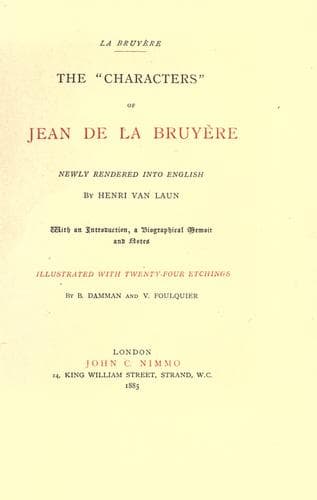
The "Characters" of Jean de La BruyèreLa Bruyère, Jean de
General
The "Characters" of Jean de La Bruyère
La Bruyère, Jean de
Character sketches -- Early works to 1800; Characters and characteristics
(6.) A man in health questions whether there is a God, and he also
doubts whether it be a sin to have intercourse with a woman, who is at
liberty to refuse;[858] but when he falls ill, or when his mistress is
with child, she is discarded, and he believes in God.
(7.) People should examine themselves thoroughly before openly
declaring themselves freethinkers, so that, according to their own
principles, they at least may die as they have lived; or if they find
they are not strong-minded enough to proceed so far, to resolve to
live as they would wish to die.
(8.) Jesting in a dying man is out of place; and if it is on certain
subjects, it is dreadful. To please our survivors with a jest at the
expense of our own eternal happiness, is a very miserable business.
Whatever a man may think about a future state, dying is a very serious
affair, and firmness is then more becoming than jesting.
(9.) In all ages there have been people with a certain amount of
cleverness, and well read, who, servilely following men of high rank,
embraced their loose principles, and all their lifetime groaned under
their yoke, against their own knowledge and conscience. Some men only
live for other men, and seem to consider themselves created for this
purpose; they are ashamed to be seen bestowing a thought on their own
salvation, and to appear outwardly such as they are perhaps in their
hearts, and thus they ruin themselves out of deference or complacency.
Are there then on this earth men of such high rank and so very powerful
as to deserve that we should shape our beliefs and our lives according
to their taste and fancy; nay, that we should carry our submission
so far as at our death to leave this world not in the safest way for
ourselves, but in the way most pleasing to them?
(10.) Men who run counter to all the world, and act against principles
universally received, should know more than other men, be clear in
their reasons and convincing in their arguments.
(11.) A sober-minded, cool-headed, chaste, and honourable man, who
affirms there is no God, at least is dispassionate, but such a man is
not to be found.
(12.) I admit I should very much like to see a man really persuaded
there was no God; for then I should at least hear on what unanswerable
arguments his unbelief is founded.
(13.) The impossibility I find myself under of proving there is no God,
is to me a convincing argument for His existence.
(14.) God condemns and punishes those who offend Him, and He is the
only judge in His own cause, which would shock all our ideas if He
Himself were not Justice and Truth—that is, if He were not God.
Public-domain text, read in full here on John Shaqi.
Reviews
Reviews
No reviews yet
Be the first to share your thoughts on this work.
Elsewhere in the archive
Join the Discussion
Join the discussion
Sign in to leave a comment or review.
Sign InorCreate an account