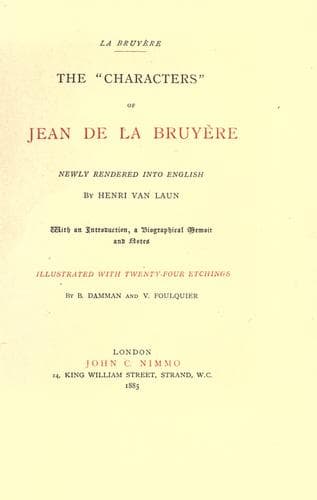
The "Characters" of Jean de La BruyèreLa Bruyère, Jean de
General
The "Characters" of Jean de La Bruyère
La Bruyère, Jean de
Character sketches -- Early works to 1800; Characters and characteristics
(30.) It is not proper for all men to profess to give alms and to have
the common beggars of the parish daily crowding at their doors, and not
allow one to go home empty-handed. Who is not aware that there is a
more concealed wretchedness, which may be relieved, either immediately
and out of a manʼs own pocket, or at least by the intercession of
others? In the same manner all persons are not qualified for the
pulpit, nor fit to expound the Word of God in public, either as
missionaries, or teachers; but what man does not, some time or other,
meet a freethinker, whom he might attempt to reclaim and bring back to
the fold by gentle and insinuating converse about the submission due to
the teachings of the church? Should a man make but one convert in the
whole course of his life, he cannot be said to have lived in vain, or
to have been a useless burden on this earth.
(31.) There are two worlds: one we dwell in but a short time, and
which we must leave never to return; another, to which we must shortly
go, there to abide for ever. Interest, authority, friends, a great
reputation, and riches are most useful in the first; an indifference to
all these things is most useful for the next. It is a mere question of
choice.
(32.) A man who lives a day lives an age; always the same sun, the
same earth, the same world, the same sensations; to-day will precisely
be like to-morrow; we ought to feel some curiosity to die, for then
we are no longer a body, but only a spirit. However, man, though so
impatiently hunting after novelties, is not anxious to die; restless
and tired of everything, he is not tired of life, and would, perhaps,
be satisfied to live for ever. What he sees of death makes a deeper
impression on him than what he knows of it; sickness, pain, and the
grave, make him dislike the knowledge of another world; and the
strongest religious motives are needed to convert him.
(33.) If Providence had left it to our choice to die or to live for
ever, we should carefully consider how dismal it is for a man to see
no end to his poverty, servitude, annoyance, or sickness; or, at best
to enjoy riches, grandeur, pleasures, and health, only in time to
behold them invariably change to their opposite conditions; and thus
to be tossed to and fro between happiness and misery, and, therefore,
we should be greatly perplexed; but Nature has settled it for us, and
saves us the trouble of making a choice, as it has imposed on us the
necessity of dying, which is, moreover, alleviated by religion.
Public-domain text, read in full here on John Shaqi.
Reviews
Reviews
No reviews yet
Be the first to share your thoughts on this work.
Elsewhere in the archive
Join the Discussion
Join the discussion
Sign in to leave a comment or review.
Sign InorCreate an account