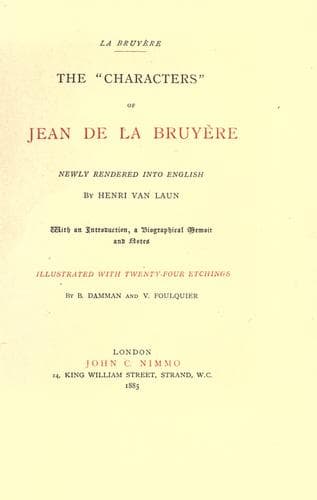
The "Characters" of Jean de La BruyèreLa Bruyère, Jean de
General
The "Characters" of Jean de La Bruyère
La Bruyère, Jean de
Character sketches -- Early works to 1800; Characters and characteristics
[102] In the original _comédies_, a word employed for tragedies as well
as for comedies.
[103] Cinna in the tragedy of that name, Felix in _Polyeucte_, and
Rodogune in _Rodogune_ are examples of this.
[104] The original has _nombreux_, the Latin _numerosus_.
[105] Three tragedies by Corneille. Though he himself calls the last
tragedy by the name given above, its real title is _Horace_.
[106] Mithridates, the hero of Racineʼs tragedy of that name; Porus, a
character in the _Alexandre_, and Burrhus in the _Britannicus_ of the
same author.
[107] In the comparison between Corneille and Racine there are some
reminiscences of a _Parallèle de M. Corneille et de M. Racine_,
published in 1686 by a certain author, de Requeleyne, Baron de
Longepierre.
[108] Sophocles (495-406 B.C.), Euripides (480-406 B.C.)
[109] Cassius Longinus (213-273), a Greek orator, philosopher, and
author, is chiefly known by his “Treatise on the Sublime,” which is
generally attributed to him. In it he states that there are five
principal sources of the sublime, and that the third is nought but
the figures of speech turned about in a certain manner. Boileauʼs
translation of this “Treatise” appeared in 1674, and in his preface he
described but did not define the sublime, a definition also not found
in Longinus.
[110] The original has _capable_, in the sense of the Latin _capax_.
[111] According to Boileau, Longinus does not understand by “sublime” a
sublime style, but something extraordinary and marvellously striking,
which causes a work to enrapture, delight, and transport us. A sublime
style always requires grand, eloquent words; but the sublime may be
found in a single thought, a single figure of speech, a single phrase.
Longinus himself says that anything which leaves us food for thought,
which almost carries us away, and of which the remembrance is lasting,
is sublime.
[112] In rhetoric there is a difference between a metaphor and a
comparison.
[113] The above paragraph is said to refer to the polemical writings
interchanged between the Jesuits and Jansenists, and seems not quite
fair to Pascalʼs _Lettres Provinciales_.
[114] Some “Keys” mention the names of Bouhours and Bourdaloue, whilst
more modern commentators think that La Bruyère only wished to give a
paragraph on the French prose of his time.
[115] The original has _artisan_, which even in La Bruyèreʼs time meant
an artisan, when used without being qualified; our author employs it,
however, for “artist.”
[116] Some annotators say a certain Abbé Bourdelon (1653-1730), a
completely forgotten critic, was meant; others think it was a hit at
Ménage (1613-1692), who had the good sense not to recognise himself in
this portrait, and is said to have been also the original of Vadius in
Molièreʼs _Femmes Savantes_.
Public-domain text, read in full here on John Shaqi.
Reviews
Reviews
No reviews yet
Be the first to share your thoughts on this work.
Elsewhere in the archive
Join the Discussion
Join the discussion
Sign in to leave a comment or review.
Sign InorCreate an account