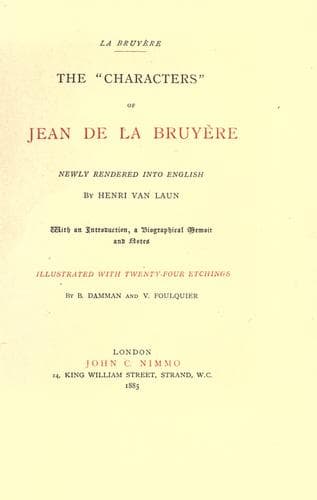
The "Characters" of Jean de La BruyèreLa Bruyère, Jean de
General
The "Characters" of Jean de La Bruyère
La Bruyère, Jean de
Character sketches -- Early works to 1800; Characters and characteristics
(47.) There exist miseries in this world which wring the very heart;
some people want even food; they dread the winter and are afraid
to live; others eat hothouse fruits; the earth and the seasons are
compelled to furnish forth delicacies; and mere citizens, simply
because they have grown rich, dare to swallow in one morsel what would
nourish a hundred families. Whatever may be brought forward against
such extremes, let me be neither unhappy or happy if I can help it; I
take refuge in mediocrity.
(48.) It is well known that the poor are sad because they want
everything and nobody comforts them; but if it be true that the rich
are irascible, it is because they may want the smallest thing, or that
some one might oppose them.
(49.) A man is rich whose income is larger than his expenses, and he is
poor if his expenses are greater than his income.
There are some men[295] who with an annual revenue of two millions are
yearly still five hundred thousand _livres_ in arrears.
Nothing keeps longer than a middling fortune, and nothing melts away
sooner than a large one.
Great riches are a temptation for poverty.
If it be true that a man is rich who wants nothing, a wise man is a
very rich man.[296]
If a man be poor who wishes to have everything, then an ambitious and a
miserly man languish in extreme poverty.
(50.) Passions tyrannise over mankind, but ambition keeps the others in
abeyance, and makes for a while a man appear to possess every virtue.
I once believed that Tryphon, whom I now know to practise every vice,
was sober, chaste, liberal, modest, and even pious; I might have
believed so still if he had not made his fortune.
(51.) All that a man wishes for is riches and grandeur; he falls very
ill, and death draws near, and though his face be shrivelled and his
legs totter, yet he is still talking of his fortune and his post.
(52.) There are but two ways of rising in the world, either by your
own industry or by the folly of others.
(53.) The features may indicate the natural disposition, habits, and
morals of a man, but it is the expression of the whole countenance that
discovers his wealth; it is written in a manʼs face whether he has more
or less than a thousand _livres_ a year.
(54.) Chrysantes, a wealthy and impertinent man, would think it a
disgrace to be seen with Eugenius, who is a man of merit but poor;
Eugenius entertains the same feelings towards Chrysantes; so there is
no chance of their ever quarrelling together.
Public-domain text, read in full here on John Shaqi.
Reviews
Reviews
No reviews yet
Be the first to share your thoughts on this work.
Elsewhere in the archive
Join the Discussion
Join the discussion
Sign in to leave a comment or review.
Sign InorCreate an account