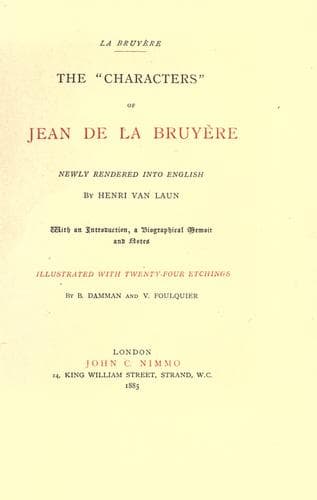
The "Characters" of Jean de La BruyèreLa Bruyère, Jean de
General
The "Characters" of Jean de La Bruyère
La Bruyère, Jean de
Character sketches -- Early works to 1800; Characters and characteristics
Phædo has sunken eyes, a reddish complexion, a lean body and an
emaciated countenance; he sleeps very little, and his slumbers are
light; he is absent-minded, pensive, and, with some intelligence, looks
like a dolt; he forgets to say what he knows or to speak about those
incidents with which he is acquainted; if he says something now and
then, he does it badly; he thinks he bores those persons to whom he
addresses himself, and therefore tells his story briefly but coldly, so
that he is never listened to nor taken notice of, for he makes nobody
laugh. He praises and laughs at other personsʼ jests, is of their
opinions, and runs and flies to render them some small services; he
is over polite, and flatters and waits on them; he is close about his
own affairs, and does not always tell the truth about them; he is very
peculiar,[320] scrupulous, and timorous. He steps lightly and softly,
and seems afraid to tread the ground; he walks with his eyes downward,
and dares not raise them to face the passers-by; he never joins in any
conversation, but places himself behind the person who speaks; picks up
by stealth all that has been said, and withdraws if any one looks at
him. He does not take up any room nor fill a place anywhere; he walks
about with his arms close to his body, his hat over his eyes that he
may not be seen, and wraps and folds himself up in his cloak. There is
no street nor gallery so crowded and filled with people, but he finds
a way to get through without jostling, and to steal along unperceived.
If they beg him to sit down, he seats himself on the edge of a chair,
and talks in a low voice and not very distinctly; he freely expresses,
however, his opinion on public affairs, is angry with the age, and but
indifferently pleased with the cabinet and the ministers; he seldom
opens his mouth but to reply; he coughs and blows his nose with his
hat before his face, he almost expectorates on himself, and does not
sneeze till he is alone, or if it does happen, no one hears it, so that
no one has to say “God bless you.” He is poor.[321]
[Illustration]
VII.
OF THE TOWN.[322]
(1.) People in Paris, without giving any notice beforehand, and as if
it were some public assignation, meet every evening on the Cours[323]
or in the Tuileries, to stare around and criticise one another.
They cannot dispense with those very persons whom they do not like and
whom they deride.
They wait for one another in these public walks,[324] and they examine
one another; carriages, horses, liveries, coats of arms, nothing
escapes their gaze; everything is looked at keenly or maliciously, and
they respect or contemn the persons they meet according to the greater
or lesser splendour of their equipages.
Public-domain text, read in full here on John Shaqi.
Reviews
Reviews
No reviews yet
Be the first to share your thoughts on this work.
Elsewhere in the archive
Join the Discussion
Join the discussion
Sign in to leave a comment or review.
Sign InorCreate an account