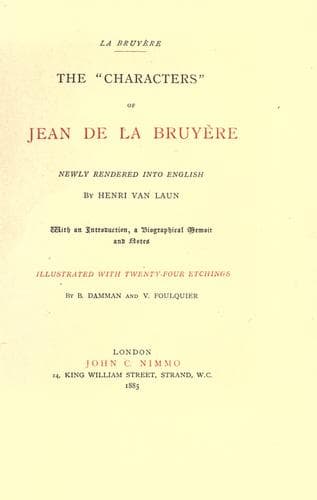
The "Characters" of Jean de La BruyèreLa Bruyère, Jean de
General
The "Characters" of Jean de La Bruyère
La Bruyère, Jean de
Character sketches -- Early works to 1800; Characters and characteristics
(9.) The Crispins join and club together to drive out with six horses
to their carriage, and with a swarm of men in livery, to which each
has furnished his share; they figure at the Cours or at Vincennes[332]
as brilliantly as a newly-married couple, or as Jason who is ruining
himself, or as Thraso who wishes to get married, and who has deposited
the money to buy an important place.[333]
(10.) I hear a good deal of talk about the Sannions; about “the same
name, the same arms, the elder branch, the younger branch, the younger
sons of the second branch; about the first bearing their arms plain,
the second with a label, and the third with a _bordure_ indented.”
Their colour and metal are the same as those of the Bourbons, and, like
them, they bear two and one;[334] it is true these are not “fleurs
de lis,” but they are satisfied; perhaps, in their inmost hearts,
they believe their bearings as noble; at least, they are the same as
those of lords of the highest rank who are quite content with them.
We see them on their mourning hangings,[335] and on the windows of
their chapels, on the gates of their castle, on their justiciary
pillar, where many a man is condemned to be hanged who only deserved
banishment; they are visible anywhere, on their furniture and their
locks, while their carriages are covered with them, and the liveries
of their servants do not disgrace their escutcheon. I should like to
tell the Sannions that their ostentation is too precipitate; that they
should have waited at least until their race had existed a century;
that those persons who knew and conversed with their grandfather are
old and cannot live long, and that, after their death, no one will be
able to say where he kept his shop, and what a very dear one it was.
The Sannions and the Crispins[336] had rather be thought extravagant
than covetous; they tell you a long story of a feast or a collation
they gave, of their losses at play, and express aloud their regrets
they have not lost more. They mention in their peculiar language
certain ladies of their acquaintance; they have ever many pleasant
things to tell each other, are always making new discoveries, and
confide to one another their successes with the fair. One of them,
coming lately to his country-house, hastens to bed, and rises with the
dawn, then puts on his gaiters and a linen suit, and fastens on his
belt and his powder-horn, ties back his hair, takes his gun, and is
a sportsman, if he did but shoot well. He returns at night, wet and
weary, without any game, but goes shooting again on the morrow, and
spends the whole day in missing thrushes and partridges.
Public-domain text, read in full here on John Shaqi.
Reviews
Reviews
No reviews yet
Be the first to share your thoughts on this work.
Elsewhere in the archive
Join the Discussion
Join the discussion
Sign in to leave a comment or review.
Sign InorCreate an account