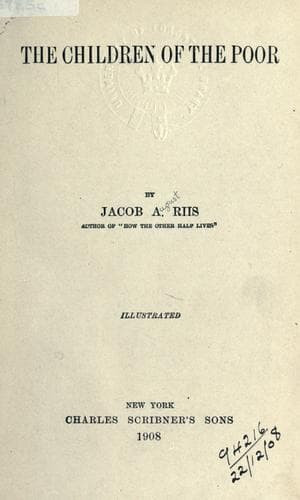
The Children of the PoorRiis, Jacob A. (Jacob August)
History
The Children of the Poor
Riis, Jacob A. (Jacob August)
Child welfare -- New York (State) -- New York; Poor; Poor -- New York (State) -- New York
In the case of the little John Does a doubt arises which the Society
settles by passing them on to the best institution available for each
particular child, quite irrespective of sect. There are thirteen of them
by this time, waifs found in the street by the Society's agents or friends
and never claimed by anybody. Though passed on, in the plan of the Society
from which it never deviates, to be cared for by others, they are never
lost sight of but always considered its special charges, for whom it bears
a peculiar responsibility.
Poor little Carmen, of whom I spoke in the chapter about Italian children,
was one of the Society's wards. Its footprints may be found all through
these pages. To its printed reports, with their array of revolting cruelty
and neglect, the reader is referred who would fully understand what a gap
in a Christian community it bridges over.
[Illustration: CLUB WITH WHICH A FOUR-YEAR-OLD CHILD WAS BRUTALLY
BEATEN.]
CHAPTER X.
THE STORY OF THE FRESH AIR FUND
The last echoes of the storm raised by the story of little Mary Ellen had
not died in the Pennsylvania hills when a young clergyman in the obscure
village of Sherman preached to his congregation one Sunday morning from
the text, "Inasmuch as ye did it unto one of these my brethren, even these
least, ye did it unto me," a sermon which in its far-reaching effects was
to become one of the strongest links in the chain of remorseful human
sympathy then being forged in the fires of public indignation. Willard
Parsons was a man with a practical mind as well as an open heart. He had
lived in the city and had witnessed the suffering of the poor children in
the stony streets on the hot summer days. Out there in the country he saw
the wild strawberry redden the fields in June only to be trampled down by
the cattle, saw, as the summer wore on, the blackberry-vines by the
wayside groaning under their burden of sweet fruit, unconsidered and going
to waste, with this starved host scarce a day's journey away. Starved in
body, in mind, and in soul! Not for them was the robin's song _they_
scarcely heard; not for them the summer fields or the cool forest shade,
the sweet smell of briar and fern. Theirs was poverty and want, and heat
and suffering and death--death as the entrance to a life for which the
slum had been their only preparation. And such a preparation!
Public-domain text, read in full here on John Shaqi.
Reviews
Reviews
No reviews yet
Be the first to share your thoughts on this work.
Elsewhere in the archive
Join the Discussion
Join the discussion
Sign in to leave a comment or review.
Sign InorCreate an account