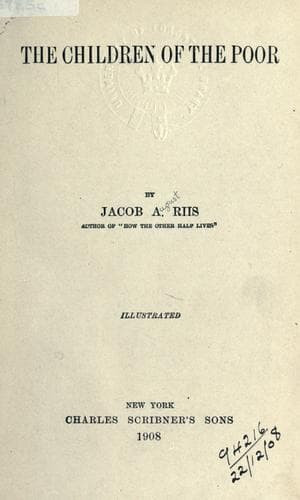
The Children of the PoorRiis, Jacob A. (Jacob August)
History
The Children of the Poor
Riis, Jacob A. (Jacob August)
Child welfare -- New York (State) -- New York; Poor; Poor -- New York (State) -- New York
Once there, what wondrous things those little eyes behold, whose horizon
was limited till that day, likely enough, by the gloom of the filthy
court, or the stony street upon which it gave, with the gutter the
boundary line between! The daisies by the roadside, with no sign to warn
them "off the grass," the birds, the pig in its sty, the cow with its
bell--each new marvel is hailed with screams of delight. "Sure, heaven
can't be no nicer place than this," said a little child from one of the
missions who for the first time saw a whole field of daisies; and her
fellow-traveller, after watching intently a herd of cows chew the cud
asked her host, "Say, mister, do you have to buy gum for all them cows to
chew?"
The children sent out by the Fresh Air Fund go as guests always. No penny
of it is spent in paying for board. It goes toward paying their way only.
Most of the railroad companies charge only one-fourth of the regular fare
for the little picnickers up to the maximum of $3.50; beyond that they
carry them without increase within the five hundred mile limit. Last year
Mr. Parsons' wards were scattered over the country from the White
Mountains in the East to Western Pennsylvania, from the lakes to West
Virginia. New Hampshire, Massachusetts, Vermont, Connecticut, New York,
New Jersey, Pennsylvania, Maryland, and West Virginia were hosts, and
Canada entertained one large party. Ohio and North Carolina were on the
list of entertainers, but the way was too long for the children. The
largest party that went out comprised eleven hundred little summer
boarders.
Does any good result to the children? The physical effect may be summed up
in Dr. Daniel's terse statement, after many years of practical interest in
the work: "I believe the Fresh Air Fund is the best plaster we have for
the unjust social condition of the people." She spoke as a doctor,
familiar with the appearance of the children when they went out and when
they came back. There are not wanting professional opinions showing most
remarkable cures to have resulted from even this brief respite from the
slum. The explanation is simple: it was the slum that was the real
complaint; with it the cause was removed and improvement came with a
bound. As to the moral and educational effect, Mr. Parsons thus answers a
clergyman who objected that "it will only make the child discontented with
the surroundings where God placed him:"
Public-domain text, read in full here on John Shaqi.
Reviews
Reviews
No reviews yet
Be the first to share your thoughts on this work.
Elsewhere in the archive
Join the Discussion
Join the discussion
Sign in to leave a comment or review.
Sign InorCreate an account