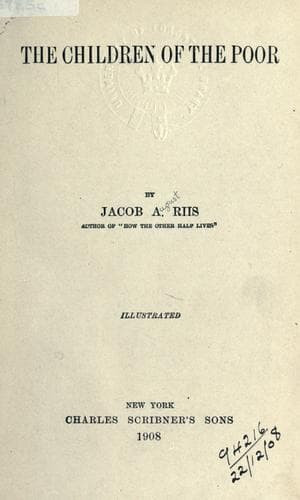
The Children of the PoorRiis, Jacob A. (Jacob August)
History
The Children of the Poor
Riis, Jacob A. (Jacob August)
Child welfare -- New York (State) -- New York; Poor; Poor -- New York (State) -- New York
The kindergarten is no longer an experiment in New York. Probably as many
as a hundred are to-day in operation, or will be when the recently
expressed purpose of the Board of Education to make the kindergarten a
part of the public school system has been fully carried out. The
Children's Aid Society alone conducts a dozen in connection with its
industrial schools, and the New York Kindergarten Association nine, if its
intention of opening two new schools by the time this book is in the
printer's hands is realized. There is no theology, though there is a heap
of religion in most of them. Protestants, Catholics, Jews, Theosophists,
and Ethical Culturists, if I may so call them, men of one or of various
opinions, or of none, concerning the hereafter, alike make use of the
kindergarten as a means of reaching and saving the shipwrecked of the
present. Sometimes the Sunday School is made to serve as a feeder for the
kindergarten, or the kindergarten for the Sunday School. Sometimes the
wisdom that wrests success from doubt and perplexity is expressed in the
fundamental resolution that the kindergarten "shall not be a Sunday
School." The system is the same in all cases with very little change. "We
have tried it and seen it tried with various kinks and variations," said
one of the old managers of the Children's Aid Society to me, "but after
all there is only one way, the way of the great kindergartner who said,
'We learn by doing.'"
A clean face is the ticket of admission to the kindergarten. A clean or
whole frock is wisely not insisted upon too firmly at the start; torn or
dirty clothes are not so easily mended as a smudged face, but the
kindergarten reaches that too in the end, and by the same road as the
Fresh Air scrubbing--the home. Once he is let in, the child is in for a
general good time that has little of school or visible discipline to
frighten him. He joins in the ring for the familiar games, delighted to
find that the teacher knows them too, and can be "It" and his "fair lady"
in her turn. He does not notice the little changes the game has undergone,
the kindergarten touch here and there that lifts it out of the mud; but
the street does presently, when the new version is transferred to it, and
is the better for it. After the game there are a hundred things for him to
do that do not seem like work in the least. Between threading colored
beads, cutting and folding pink and green papers in all sorts of odd
ways, as boats and butterflies and fancy baskets; moulding, pasting,
drawing, weaving and blowing soap-bubbles when all the rest has ceased to
hold his attention, the day slips by like a beautiful dream, and he flatly
refuses to believe that it is gone when the tenement home claims him
again. Not infrequently he goes home howling, to be found the next morning
waiting at the door an hour before the teacher comes. Little Jimmie's
mother says that he gets up at six o'clock to go to the Fifty-first Street
Public-domain text, read in full here on John Shaqi.
Reviews
Reviews
No reviews yet
Be the first to share your thoughts on this work.
Elsewhere in the archive
Join the Discussion
Join the discussion
Sign in to leave a comment or review.
Sign InorCreate an account