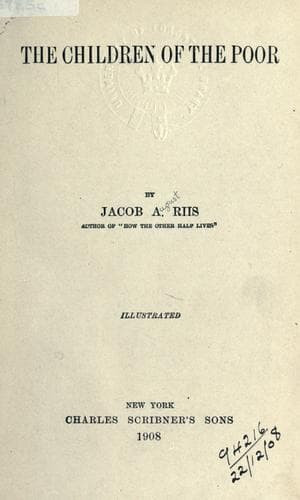
The Children of the PoorRiis, Jacob A. (Jacob August)
History
The Children of the Poor
Riis, Jacob A. (Jacob August)
Child welfare -- New York (State) -- New York; Poor; Poor -- New York (State) -- New York
While this was going on, another boy, twice as large as Johnny, had been
temporarily exiled from the ring for clumsiness. It was even more
hopelessly constitutional, to all appearances, than Johnny's Machiavelian
cunning. In the game he had persistently stumbled over his own feet. Made
to take a seat at the long table, he fell off his chair twice in one
minute from sheer embarrassment. In luminous contrast to his awkwardness
was the desperate agility of a little Irishman I had just left in another
kindergarten. Each time he was told to take his seat, which was about
every ten seconds, he would perform the feat with great readiness by
climbing over the back of the chair as a dog climbs over a fence, to the
consternation of the teacher, whose reproachful "O Alexander!" he disarmed
with a cheerful "I'm all right, Miss Brown," and an offer to shake hands.
Let it not be inferred from this that the kindergarten is the home of
disorder. Just the reverse. Order and prompt obedience are the cardinal
virtues taught there, but taught in such a way as to make the lesson seem
all fun and play to the child. It sticks all the better. It is the
province of the kindergarten to rediscover, as it were, the natural
feelings the tenement had smothered. But for its appeal, the love of the
beautiful might slumber in those children forever. In their homes there is
nothing to call it into life. The ideal of the street is caricature,
burlesque, if nothing worse. Under the gentle training of the
kindergartner the slumbering instinct blossoms forth in a hundred
different ways, from the day the little one first learns the difference
between green and red by stringing colored beads for a necklace "for
teacher," until later on he is taught to make really pretty things of
pasteboard and chips to take home for papa and mamma to keep. And they do
keep them, proud of the child--who would not?--and their influence is felt
where mayhap there was darkness and dirt only before. So the kindergarten
reaches directly into the home, too, and thither follows the teacher, if
she is the right kind, with encouragement and advice that is not lost
either. No door is barred against her who comes in the children's name. In
the truest and best sense she is a missionary to the poor.
Public-domain text, read in full here on John Shaqi.
Reviews
Reviews
No reviews yet
Be the first to share your thoughts on this work.
Elsewhere in the archive
Join the Discussion
Join the discussion
Sign in to leave a comment or review.
Sign InorCreate an account