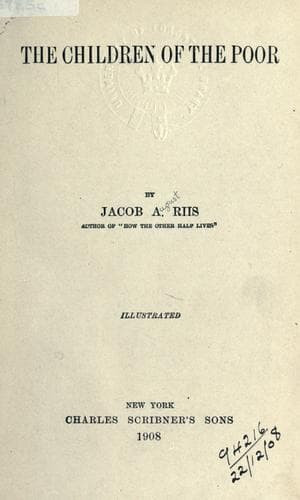
The Children of the PoorRiis, Jacob A. (Jacob August)
History
The Children of the Poor
Riis, Jacob A. (Jacob August)
Child welfare -- New York (State) -- New York; Poor; Poor -- New York (State) -- New York
The kindergarten is the city's best truant officer. Not only has it no
truants itself, but it ferrets out a lot who are truants from necessity,
not from choice, and delivers them over to the public school. There are
lots of children who are kept at home because someone has to mind the baby
while father and mother earn the bread for the little mouths. The
kindergarten steps in and releases these little prisoners. If the baby is
old enough to hop around with the rest, the kindergarten takes it. If it
can only crawl and coo, there is the nursery annex. Sometimes it is an
independent concern. Almost every church or charity that comes into
direct touch with the poor has nowadays its nursery where poor mothers may
leave their children to be cared for while they are out working. Relief
more practical could not be devised. A small fee, usually five cents, is
charged as a rule for each baby. Pairs come cheaper, and three go for ten
cents at the nursery in the Wilson mission. Over 50,000 babies were
registered there last year, which meant, if not 5,000 separate children,
at least 5,000 days' work and wages to poor mothers in dire need of both,
and a good, clean, healthy start for the infants, a better than the
tenement could have given them. To keep them busy, when the rocking-horse
and the picture-book have lost their charm, the kindergarten grows
naturally out of the nursery, where that was the beginning, just as the
nursery stepped in to supplement the kindergarten where that had the lead.
The two go hand in hand. The soap cure is even more potent in the nursery
than in the kindergarten, as a silent rebuke to the mother, who rarely
fails to take the hint. At the Five Points House of Industry the children
who come in for the day receive a general scrubbing twice a week, and the
whole neighborhood has a cleaner look after it. The establishment has come
to be known among the ragamuffins of Paradise Park as "the school where
dey washes 'em." Its value as a moral agent may be judged from the
statements of the Superintendent that some of the children "cried at the
sight of a washtub," as if it were some new and hideous instrument of
torture for their oppression.
Public-domain text, read in full here on John Shaqi.
Reviews
Reviews
No reviews yet
Be the first to share your thoughts on this work.
Elsewhere in the archive
Join the Discussion
Join the discussion
Sign in to leave a comment or review.
Sign InorCreate an account