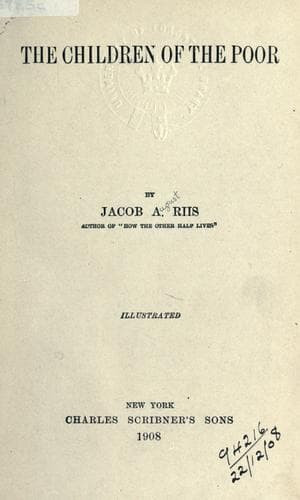
The Children of the PoorRiis, Jacob A. (Jacob August)
History
The Children of the Poor
Riis, Jacob A. (Jacob August)
Child welfare -- New York (State) -- New York; Poor; Poor -- New York (State) -- New York
speak another language at home than the one they come to the school to
learn, and often have to work their way in by pantomime. It is encouraging
to know that these schools are almost always crowded to their utmost
capacity.
A census of the Society's twenty-one day schools, that was taken last
April, showed that they contained that day 5,132 pupils, of whom 198 were
kindergarten children under five years of age, 2,347 between five and
seven, and 2,587 between eight and fourteen years of age. Considerably
more than ten per cent.--the exact number was 571--did not understand
questions put to them in English. They were there waiting to "catch on,"
silent but attentive observers of what was going on, until such time as
they should be ready to take a hand in it themselves. Divided according to
nativity, 2,082 of the children were found to be of foreign birth. They
hailed from 22 different countries; 3,050 were born in this country, but
they were able to show only 1,009 native parents out of 6,991 whose
pedigrees could be obtained. The other 5,176 were foreign born, and only
810 of them claimed English as their mother-tongue. This was the showing
the chief nationalities made in the census:
-------------+---------+--------
Born in. |Children.|Parents.
-------------+---------+--------
United States| 3,050 | 1,009
-------------+---------+--------
Italy | 1,066 | 2,354
-------------+---------+--------
Germany | 460 | 1,819
-------------+---------+--------
Bohemia | 198 | 720
-------------+---------+--------
Ireland | 98 | 583
-------------+---------+--------
At that time the Jewish children were crowding into the Monroe Street and
some other schools, at a rate that promised to put them in complete
possession before long. Upon this lowest level, as upon every other where
they come into competition with the children of Christian parents, they
distanced them easily, taking all the prizes that were to be had for
regular attendance, proficiency in studies, and good conduct generally.
Generally these prizes consisted of shoes or much-needed clothing. Often,
as in the Monroe Street School, the bitter poverty of the homes that gave
up the children to the school because there they would receive the one
square meal of the day, made a loaf of bread the most acceptable reward,
and the teachers gladly took advantage of it as the means of forging
another link in the chain to bind home and school, parents, children, and
teachers, firmly together.
Public-domain text, read in full here on John Shaqi.
Reviews
Reviews
No reviews yet
Be the first to share your thoughts on this work.
Elsewhere in the archive
Join the Discussion
Join the discussion
Sign in to leave a comment or review.
Sign InorCreate an account