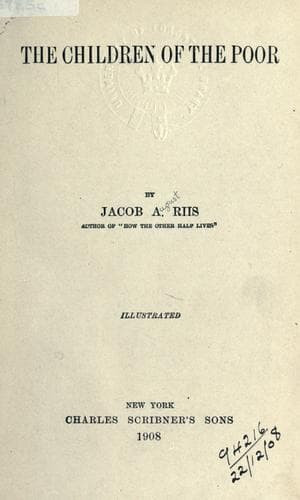
The Children of the PoorRiis, Jacob A. (Jacob August)
History
The Children of the Poor
Riis, Jacob A. (Jacob August)
Child welfare -- New York (State) -- New York; Poor; Poor -- New York (State) -- New York
hostility to the school, in the pupil. The teacher has only to threaten
the intractable ones with being sent home to bring them round. And yet, it
is not that they are often cruelly treated there. On the contrary, the
Bohemian is an exceptionally tender and loving father, perhaps because his
whole life is lived with his family at home, in the tenement that is his
shop and his world. He simply proposes that his child shall enjoy the
advantages that are denied him--denied partly perhaps because of his
refusal to accept them, but still from his point of view denied. And he
takes a short cut to that goal by sending the child to school. The result
is that the old Bohemian disappears in the first generation born upon our
soil. His temper remains to some extent, it is true. He still has his
surly streaks, refuses to sing or recite in school when the teacher or
something else does not suit him, and can never be driven where yet he is
easily led; but as he graduates into the public school and is thrown more
into contact with the children of more light-hearted nationalities, he
grows into that which his father would have long since become, had he not
got a wrong start: a loyal American, proud of his country, and a useful
citizen.
In the school in East Seventy-third Street, of which I am thinking, there
was last winter, besides the day school of some four hundred pupils, an
evening class of big factory girls, most of them women grown, that vividly
illustrated the difficulties that beset teaching in the Bohemian quarter.
It had been got together with much difficulty by the principal and one of
the officers of the Society, who gave up his nights and his own home life
to the work of instructing the school. On the night when it opened, he was
annoyed by a smell of tobacco in the hallways and took the janitor to task
for smoking in the building. The man denied the charge, and Mr. H---- went
hunting through the house for the offender with growing indignation, as he
found the teachers in the class-rooms sneezing and sniffing the air to
locate the source of the infliction. It was not until later in the
evening, when the sneezing fit took him too as he was bending over a group
of the girls to examine their slates, that he discovered it to be a
feature of the new enterprise. The perfume was part of the school. Without
it, it could not go on. The girls were all cigar makers; so were their
parents at home. The shop and the tenement were organized on the tobacco
plan, and the school must needs adopt it with what patience it could, if
its business were to proceed.
Public-domain text, read in full here on John Shaqi.
Reviews
Reviews
No reviews yet
Be the first to share your thoughts on this work.
Elsewhere in the archive
Join the Discussion
Join the discussion
Sign in to leave a comment or review.
Sign InorCreate an account