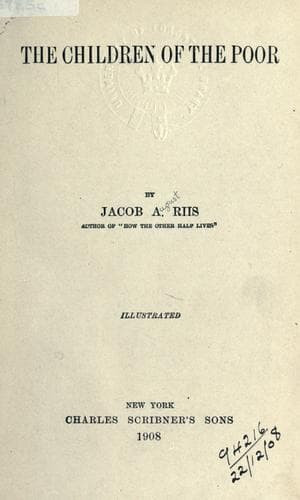
The Children of the PoorRiis, Jacob A. (Jacob August)
History
The Children of the Poor
Riis, Jacob A. (Jacob August)
Child welfare -- New York (State) -- New York; Poor; Poor -- New York (State) -- New York
"One of our great difficulties," says the Secretary of the Children's Aid
Society, in a recent statement of the Society's aims and purposes, echoing
an old grievance, "is with the large boys of the city. There seems to be
no place for them in the world as it is. They have grown up in it without
any training but that in street trades. The trades unions have kept them
from being apprenticed. They are soon too large for street occupations,
and are unable to compete with the small boys. They are too old for our
lodging-houses. We know not what to do with them. Some succeed well on
Western farms, but they are usually disliked by their employers because
they change places soon; and their occasional offences and disposition to
move about have given us more trouble in the West than any other one
thing. Very few people are willing to bear with them, even though a little
patience will sometimes bring out excellent qualities in them." They are
the boys for whom the street and the saloon have use that shall speedily
fashion of their "excellent qualities" a lash to sting the community's
purse, if not its conscience, with the memory of its neglect. As 107.75 is
to 24.53, or 140 to 9.96, so will be the smart of it compared with the
burden of patience that would have turned the scales the other way, to put
the matter in a light where the hard-headed man of business can see it
without an effort.
There is at least one man of that kind in New York who has seen and
understood it to some purpose. His name is Richard T. Auchmuty, and he is
by profession an architect. In that capacity he has had opportunity enough
of observing how the virtual exclusion of the New York boy from the trades
worked to his harm, and he started for his relief an Industrial School
that deserves to be ranked among the great benefactions of our day, even
more for its power to set people to thinking than for the direct benefit
it confers upon the boy, great as that is. Once it comes to be thoroughly
understood that a chance to learn his father's honest trade is denied the
New York boy by a foreign conspiracy, because he is an American lad and
cannot be trusted to do its bidding, it is inconceivable that an end
should not be put in quick order to this astounding abuse. This thing is
exactly what is being done in New York now by the consent of its citizens,
who without a protest read in the newspapers that a trades-union, one of
the largest and strongest in the building trades, has decreed that for two
years from a fixed date no apprentice shall be admitted to that trade in
New York--decreed, with the consent and connivance of subservient
employers, that so many lads who might have become useful mechanics shall
grow up tramps and loafers; decreed that a system of robbery of the
American mechanic shall go on by which it has come to pass that out of
twenty-three millions of dollars paid in a year to the building trades in
this city barely six millions are grudgingly accorded the native worker.
Public-domain text, read in full here on John Shaqi.
Reviews
Reviews
No reviews yet
Be the first to share your thoughts on this work.
Elsewhere in the archive
Join the Discussion
Join the discussion
Sign in to leave a comment or review.
Sign InorCreate an account