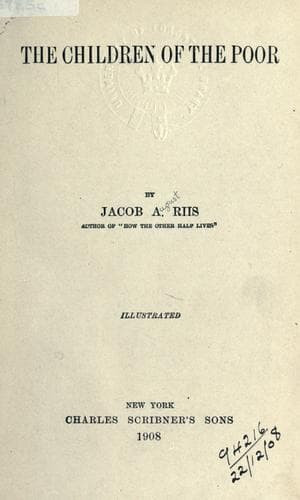
The Children of the PoorRiis, Jacob A. (Jacob August)
History
The Children of the Poor
Riis, Jacob A. (Jacob August)
Child welfare -- New York (State) -- New York; Poor; Poor -- New York (State) -- New York
The negotiations are rarely prolonged. Each picks out his
child, sometimes two, often more than one the same child. The committee
umpires between them. They all know each other, and the agent's knowledge
of each child, gained on the way out and perhaps through previous
acquaintance, helps to make the best choice. There is no ceremony of
adoption. That is left to days to come, when the child and the new home
have learned to know each other, and to the watchful care of the local
committee. To any questions concerning faith or previous condition that
may be asked, the Society's answer is always the same. In substance it is
this:
"We do not know. Here is the child. Take him and make a good Baptist, or
Methodist, or Christian of any sect of him! That is your privilege and his
gain. The fewer questions you ask the better. Let his past be behind him
and the future his to work out. Love him for himself."[23]
And in the spirit in which the advice is given it is usually accepted.
Night falls upon a joyous band returning home over the quiet country
roads, the little stranger snugly stowed among his new friends, one of
them already, with home and life before him.
And does the event justify the high hopes of that home journey? Almost
always in the end, if the child was young enough when it was sent out.
Sometimes a change has to be made. Oftener the change is of name, in the
adoption that follows. Some of the boys get restless as they grow up, and
"run about a good deal," to the anguish of the committee. A few are
reported as having "gone to the bad." But even these commonly come out all
right at last. One of them, of whom mention is made in the Society's
thirty-fifth annual report, turned up after long years as Mayor of his
town and a member of the legislature. "We can think," wrote Mr. Brace
before his death, "of little Five Points thieves who are now ministers of
the gospel or honest farmers; vagrants and street children who are men in
professional life; and women who, as teachers or wives of good citizens,
are everywhere respected; the children of outcasts or unfortunates whose
inherited tendencies have been met by the new environment, and who are
industrious and decent members of society." Only by their losing
themselves does the Society lose sight of them. Two or three times a year
the agent goes to see them all. In the big ledgers in St. Mark's Place
each child who has been placed out has a page to himself on which all his
doings are recorded, as he is heard of year by year. There are twenty-nine
of these canvas-bound ledgers now, and the stories they have to tell would
help anyone, who thinks he has lost faith in poor human nature, to pick it
up with the vow never to let go of it again. I open one of them at random,
and copy the page--page 289 of ledger No. 23. It tells the story of an
English boy, one of four who were picked up down at Castle Garden twelve
years ago. His mother was dead, and he had not seen his father for five
Public-domain text, read in full here on John Shaqi.
Reviews
Reviews
No reviews yet
Be the first to share your thoughts on this work.
Elsewhere in the archive
Join the Discussion
Join the discussion
Sign in to leave a comment or review.
Sign InorCreate an account