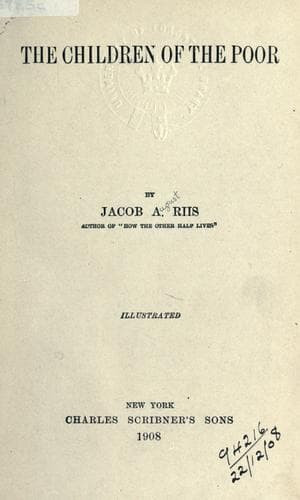
The Children of the PoorRiis, Jacob A. (Jacob August)
History
The Children of the Poor
Riis, Jacob A. (Jacob August)
Child welfare -- New York (State) -- New York; Poor; Poor -- New York (State) -- New York
"To the boys now under your charge please convey my best wishes, and that
I hope that their pathways in life will be those of morality, of honor, of
health, and industry. With these four attributes as a guidance and
incentive, I can bespeak for them an honorable and happy and successful
life. The goal is for them as well as for the rich man's son. They must
learn to labor and to wait, for 'all things come to him who waits.' Many
times will the road be rugged, winding, and long, and the sky overcast
with ominous clouds. Still, it will not do to fall by the wayside and give
up. If one does, the battle of life will be lost.
"Tell the boys I am proud to have had as humble a beginning in life as
they, and that I believe it has been my salvation. I hope my success in
life, if it can be so termed, will be an incentive to them to struggle for
a respectable recognition among their fellow-men. In this country family
name cuts but little figure. It is the character of the man that wins
recognition, hence I would urge them to build carefully and consistently
for the future."
The bigger boys do not always give so good an account of themselves. I
have already spoken of the difficulty besetting the Society's efforts to
deal with that end of the problem. The street in their case has had the
first inning, and the battle is hard, often doubtful. Sometimes it is
lost. These are rarely sent West, early consignments of them having
stirred up a good deal of trouble there. They go South, where they seem to
have more patience with them. "The people there," said an old agent of the
Society to me, with an enthusiasm that was fairly contagious, "are the
most generous, kind-hearted people in the world. And they are more easy
going. If a boy turns out badly, steals and runs away perhaps, a letter
comes, asking not for retaliation or upbraiding us for letting him come,
but hoping that he will do better, expressing sorrow and concern, and
ending usually with the big-hearted request that we send them another in
his place." And another comes, and, ten to one, does better. What lad is
there whose wayward spirit such kindness would not conquer in the end?[24]
Public-domain text, read in full here on John Shaqi.
Reviews
Reviews
No reviews yet
Be the first to share your thoughts on this work.
Elsewhere in the archive
Join the Discussion
Join the discussion
Sign in to leave a comment or review.
Sign InorCreate an account