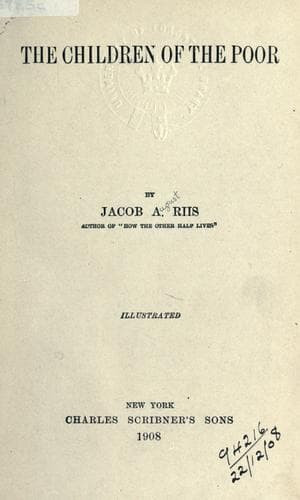
The Children of the PoorRiis, Jacob A. (Jacob August)
History
The Children of the Poor
Riis, Jacob A. (Jacob August)
Child welfare -- New York (State) -- New York; Poor; Poor -- New York (State) -- New York
A thing to be profoundly thankful for is the practical elimination of the
girl vagrant from our social life. Ten years ago, Broadway from Fourteenth
Street up was crowded with little girls who, under the pretence of
peddling flowers and newspapers, pandered to the worst immorality. They
went in regular gangs, captained and employed by a few conscienceless old
harpies, who took the wages of their infamy and paid them with blows and
curses if they fell short of their greed. The police and the officers of
the Society for the Prevention of Cruelty to Children put an end to this
traffic after a long fight, sending the old wretches to jail and some of
their victims to the reformatories. One of the gangs that were broken up
had a rendezvous in a stable in Thirtieth Street, near Broadway. The girls
had latch-keys and went out and in at all hours of the night. To-day the
flower-girl of tender years is scarcely ever met with in New York. Even
the news-girl has disappeared almost entirely and left the field to the
boys. Those who are not at work at home or in the shop have been gathered
in by the agencies for their rescue, that have multiplied with the growth
of the conviction that girl vagrancy is so much more corrosive than boy
vagabondism, as it adds sexual immorality to the other dangers of the
street. In 1881 the society's lodging-house in St. Mark's Place sheltered
1,287 girls. Their number has gone down since, as the census has gone up,
until last year it had fallen to 335, and even these were no longer
vagrants, but wayward daughters brought by their parents to be trained to
obedience and industry. In the same period, during which the city's
population increased more than one-fourth, the increase being very largely
made up of just the material to feed its homelessness, the register of the
boys' lodging-houses showed a reduction from 13,155 to 11,435.
In the introductory chapter I pointed out, as a result of the efforts made
in behalf of the children in the past generation, not only by the
Children's Aid Society, but by many kindred organizations, that the
commitments of girls and women for vagrancy fell off between the years
1860 and 1890 from 5,880 to 1,980, or from 1 in every 138-1/2 persons to 1
in every 780 of a population that had more than doubled in the interval,
while the commitments of petty girl thieves fell between 1865 and 1890
from 1 in 743 to 1 in 7,500. Illustrated by diagram this last statement
looks this way, the year 1869 being substituted as the starting-point; it
had almost exactly the same number of commitments as 1865 (see Chart A).
[Illustration: CHART A.]
Public-domain text, read in full here on John Shaqi.
Reviews
Reviews
No reviews yet
Be the first to share your thoughts on this work.
Elsewhere in the archive
Join the Discussion
Join the discussion
Sign in to leave a comment or review.
Sign InorCreate an account