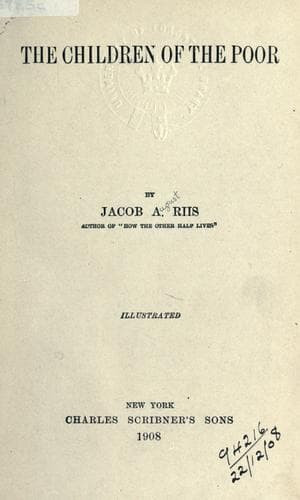
The Children of the PoorRiis, Jacob A. (Jacob August)
History
The Children of the Poor
Riis, Jacob A. (Jacob August)
Child welfare -- New York (State) -- New York; Poor; Poor -- New York (State) -- New York
But as a matter of fact that would not often
be necessary. They all have passports in which the name and ages of their
children are set down. The claim that they had purposely registered them
as younger to cheapen transportation, which they would be sure to make,
need not be considered seriously. One lie is as good and as easy as
another.
Another lesson we may learn with advantage from some old-country
governments, which we are apt to look down upon as "slow," is to punish
the parents for the truancy of their children, whether they are found
running in the street or working in a shop when they should have been at
school. Greed, the natural child of poverty, often has as much to do with
it as real need. In the case of the Italians and the Jewish girls it is
the inevitable marriage-portion, without which they would stand little
chance of getting a husband, that dictates the sacrifice. One little one
of twelve in a class in the Leonard Street School, who had been working on
coats in a sweat-shop nine months, and had become expert enough to earn
three dollars a week, told me that she had $200 in bank, and that her
sister, also a worker, was as forehanded. Their teacher supported her
story. But often a meaner motive than the desire to put money in bank
forges the child's fetters. I came across a little girl in an East Side
factory who pleaded so pitifully that she had to work, and looked so poor
and wan, that I went to her home to see what it was like. It was on the
top floor of a towering tenement. The mother, a decent German woman, was
sewing at the window, doing her share, while at the table her husband, a
big, lazy lout who weighed two hundred pounds if he weighed one, lolled
over a game of checkers with another vagabond like himself. A half-empty
beer-growler stood between them. The contrast between that pitiful child
hard at work in the shop, and the big loafer taking his ease, was enough
to make anybody lose patience, and I gave him the piece of my mind he so
richly deserved. But it rolled off him as water rolls off a duck. He
merely ducked his head, shifted his bare feet under the table, and told
his crony to go on with the play.
Public-domain text, read in full here on John Shaqi.
Reviews
Reviews
No reviews yet
Be the first to share your thoughts on this work.
Elsewhere in the archive
Join the Discussion
Join the discussion
Sign in to leave a comment or review.
Sign InorCreate an account