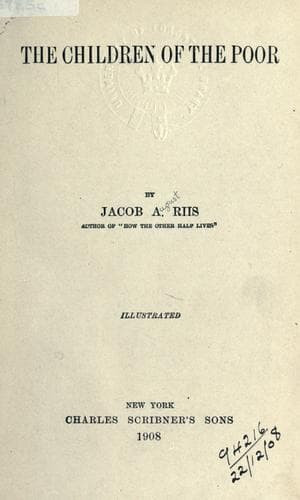
The Children of the PoorRiis, Jacob A. (Jacob August)
History
The Children of the Poor
Riis, Jacob A. (Jacob August)
Child welfare -- New York (State) -- New York; Poor; Poor -- New York (State) -- New York
There is still another kind of employment that absorbs many of the boys
and ought to be prohibited with the utmost rigor of the law. I refer to
the messenger service of the District Telegraph Companies especially.
Anyone can see for himself how old some of these boys are who carry
messages about the streets every day; but everybody cannot see the kind of
houses they have to go to, the kind of people they meet, or the sort of
influences that beset them hourly at an age when they are most easily
impressed for good or bad. If that were possible, the line would be drawn
against their employment rather at eighteen than at sixteen or fourteen.
At present there is none except the fanciful line drawn against truancy,
which, to a boy who has learned the tricks of the telegraph messenger, is
very elastic indeed.
[Illustration: MINDING THE BABY.]
To send the boys to school and see that they stay there until they have
learned enough to at least vote intelligently when they grow up, is the
bounden duty of the State--celebrated in theory but neglected in practice.
If it did its duty much would have been gained, but even then the real
kernel of this question of child labor would remain untouched. The trouble
is not so much that the children have to work early as with the sort of
work they have to do. It is, all of it, of a kind that leaves them, grown
to manhood and womanhood, just where it found them, knowing no more, and
therefore less, than when they began, and with the years that should have
prepared them for life's work gone in hopeless and profitless drudgery.
How large a share of the responsibility for this failure is borne by the
senseless and wicked tyranny of so-called organized labor, in denying to
our own children a fair chance to learn honest trades, while letting
foreign workmen in in shoals to crowd our market under the plea of the
"solidarity of labor"--a policy that is in a fair way of losing to labor
all the respect due it from our growing youth, I shall not here discuss.
The general result was well put by a tireless worker in the cause of
improving the condition of the poor, who said to me, "They are down on the
scrub level; there you find them and have to put them to such use as you
can. They don't know anything else, and that is what makes it so hard to
find work for them. Even when they go into a shop to sew, they come out
mere machines, able to do only one thing, which is a small part of the
whole they do not grasp. And thus, without the slightest training for the
responsibilities of life, they marry and transmit their incapacity to
another generation that is so much worse to start off with." She spoke of
the girls, but what she said fitted the boys just as well. The incapacity
of the mother is no greater than the ignorance of the father in the mass
of such unions. Ignorance and poverty are the natural heritage of the
children.
Public-domain text, read in full here on John Shaqi.
Reviews
Reviews
No reviews yet
Be the first to share your thoughts on this work.
Elsewhere in the archive
Join the Discussion
Join the discussion
Sign in to leave a comment or review.
Sign InorCreate an account