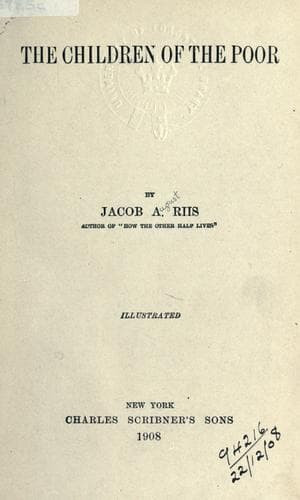
The Children of the PoorRiis, Jacob A. (Jacob August)
History
The Children of the Poor
Riis, Jacob A. (Jacob August)
Child welfare -- New York (State) -- New York; Poor; Poor -- New York (State) -- New York
Where we stood in his shop, a little boy was stacking some coats for
removal. The manufacturer pointed him out. "Now," he said, "this boy is
not fourteen years old, as you can see as well as I. His father works here
and when the Inspector comes I just call him up. He swears that the boy is
old enough to work, and there the matter ends. What would you? Is it not
better that he should be here than on the street? Bah!" And this
successful Christian manufacturer turned upon his heel with a vexed air.
It was curious to hear him, before I left, deliver a homily on the
"immorality" of the sweat-shops, arraigning them severely as "a blot on
humanity."
CHAPTER VII.
THE TRUANTS OF OUR STREETS
On my way to the office the other day, I came upon three boys sitting on a
beer-keg in the mouth of a narrow alley intent upon a game of cards. They
were dirty and "tough." The bare feet of the smallest lad were nearly
black with dried mud. His hair bristled, unrestrained by cap or covering
of any kind. They paid no attention to me when I stopped to look at them.
It was an hour before noon.
"Why are you not in school?" I asked of the oldest rascal. He might have
been thirteen.
"'Cause," he retorted calmly, without taking his eye off his neighbor's
cards, "'cause I don't believe in it. Go on, Jim!"
I caught the black-footed one by the collar. "And you," I said, "why don't
you go to school? Don't you know you have to?"
The boy thrust one of his bare feet out at me as an argument there was no
refuting. "They don't want me; I aint got no shoes." And he took the
trick.
I had heard his defence put in a different way to the same purpose more
than once on my rounds through the sweat-shops. Every now and then some
father, whose boy was working under age, would object, "We send the child
to school, as the Inspector says, and there is no room for him. What shall
we do?" He spoke the whole truth, likely enough; the boy only half of it.
There was a charity school around the corner from where he sat struggling
manfully with his disappointment, where they would have taken him, and
fitted him out with shoes in the bargain, if the public school rejected
him. If anything worried him, it was probably the fear that I might know
of it and drag him around there. I had seen the same thought working in
the tailor's mind. Neither had any use for the school; the one that his
boy might work, the other that he might loaf and play hookey.
Public-domain text, read in full here on John Shaqi.
Reviews
Reviews
No reviews yet
Be the first to share your thoughts on this work.
Elsewhere in the archive
Join the Discussion
Join the discussion
Sign in to leave a comment or review.
Sign InorCreate an account