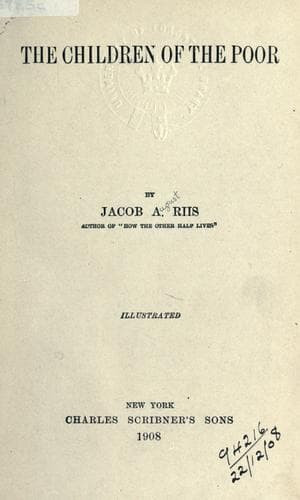
The Children of the PoorRiis, Jacob A. (Jacob August)
History
The Children of the Poor
Riis, Jacob A. (Jacob August)
Child welfare -- New York (State) -- New York; Poor; Poor -- New York (State) -- New York
The situation is this, then, that a vast horde of fifty thousand children
is growing up in this city whom our public school does not and cannot
reach; if it reaches them at all it is with the threat of the jail. The
mass of them is no doubt to be found in the shops and factories, as I have
shown. A large number peddle newspapers or black boots. Still another
contingent, much too large, does nothing but idle, in training for the
penitentiary. I stopped one of that kind at the corner of Baxter and Grand
Streets one day to catechise him. It was in the middle of the afternoon
when the schools were in session, but while I purposely detained him with
a long talk to give the neighborhood time to turn out, thirteen other lads
of his age, all of them under fourteen, gathered to listen to my business
with Graccho. When they had become convinced that I was not an officer
they frankly owned that they were all playing hookey. All of them lived in
the block. How many more of their kind it sheltered I do not know. They
were not exactly a nice lot, but not one of them would I have committed to
the chance of contact with thieves with a clear conscience. I should have
feared especial danger from such contact in their case.
As a matter of fact the record of average attendance (136,413) shows that
the public school _per se_ reaches little more than a third of all the
children. And even those it does not hold long enough to do them the good
that was intended. The Superintendent of Schools declares that the average
age at which the children leave school is twelve or a little over. It must
needs be, then, that very many quit much earlier, and the statement that
in New York, as in Chicago, St. Louis, Brooklyn, New Orleans, and other
American cities, half or more than half the school-boys leave school at
the age of eleven (the source of the statement is unknown to me) seems
credible enough. I am not going to discuss here the value of school
education as a preventive of crime. That it is, so far as it goes, a
positive influence for good I suppose few thinking people doubt nowadays.
Dr. William T. Harris, Federal Commissioner of Education, in an address
delivered before the National Prison Association in 1890, stated that an
investigation of the returns of seventeen States that kept a record of the
educational status of their criminals showed the number of criminals to be
eight times as large from the illiterate stratum as from an equal number
of the population that could read and write. That census was taken in
1870. Ten years later a canvass of the jails of Michigan, a State that had
an illiterate population of less than five per cent., showed exactly the
same ratio, so that I presume that may safely be accepted.
Public-domain text, read in full here on John Shaqi.
Reviews
Reviews
No reviews yet
Be the first to share your thoughts on this work.
Elsewhere in the archive
Join the Discussion
Join the discussion
Sign in to leave a comment or review.
Sign InorCreate an account